
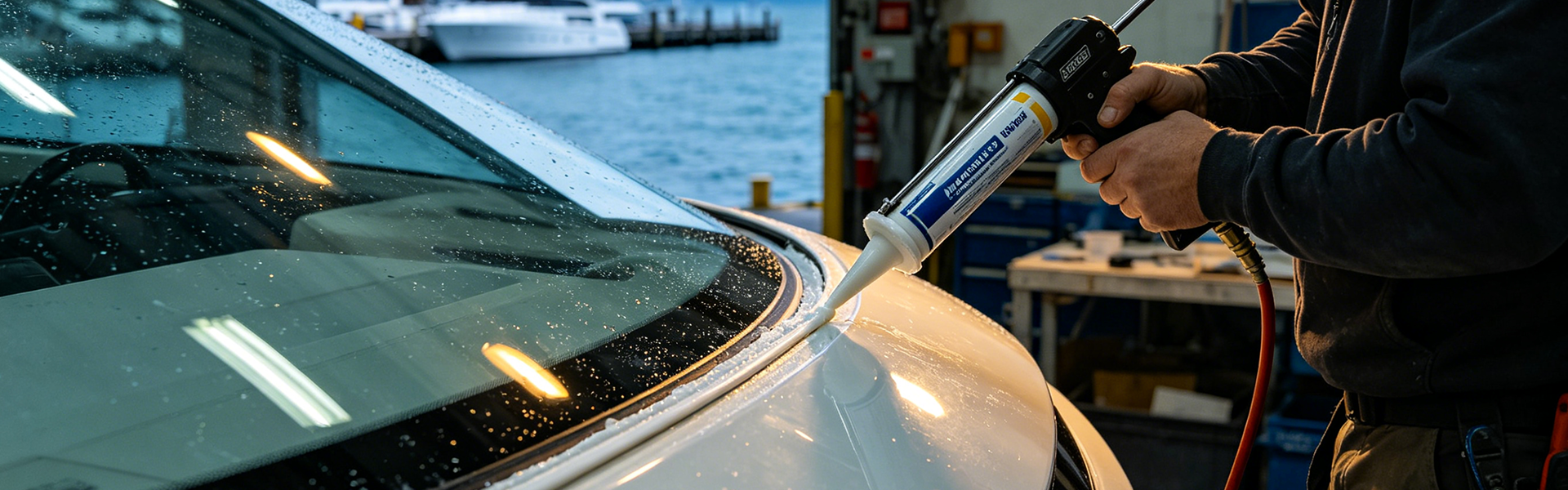
TBT (Tetra-n-Butyl Titanate, CAS 5593-70-4): Titanate Catalyst for Dealcoholisation-Cure RTV Silicone on Sensitive Substrates
SEMITECH stocks TBT at ≥98% purity (TiO₂ 14.0–14.3%) — the workhorse Ti(IV) tetra-alkoxide catalyst for dealcoholisation-cure RTV silicone applied to copper, brass, mirror-grade glass, marble and carbonate stones where acetic-acid byproduct from tin-cure would corrode or stain. Also widely used as transesterification catalyst for PET polymerisation. 25 kg HDPE jerrycan, 2–4 week ex-China lead time.
Contents
| 5593-70-4 | ≥98% | 14.0–14.3% |
|---|---|---|
| CAS number | Active content | TiO₂ content |
Chemistry & Specifications
Ti(IV) tetra-n-butoxide; clear pale-yellow liquid; MW 340.4; rapidly hydrolyses to TiO₂ + n-butanol on moisture exposure.
TBT (CAS 5593-70-4) — MW 340.4, density 1.00 g/cm³, TiO₂ assay 14.0–14.3%, water ≤0.05%, APHA ≤80. Rapidly hydrolyses on contact with atmospheric moisture — even a few drops of water will cloud the liquid within minutes. Storage under nitrogen with dry handling is more critical for TBT than almost any other silicone-industry catalyst.
Cure Mechanism: Lewis-Acid Catalysis of Silanol-Alkoxide Condensation with Alcohol Byproduct
Ti(IV) coordinates to silanol oxygen; ligand exchange with alkoxysilane; releases ethanol or methanol — no corrosive byproduct.
TBT has 5–10x lower intrinsic activity than Sn(IV) in DBTDL, requiring 0.5–2.0% loading vs 0.1% for DBTDL. Tack-free time for 1.0% TBT-loaded RTV-1 is 2–6 hours at 23°C / 50% RH, full cure 5–10 days.
- Loading 0.5–1.0% — RTV-1 alkoxy-cure on copper, mirror glass, marble
- Loading 1.0–2.0% — RTV-2 condensation cast moulds for sensitive substrates
- Loading 0.05–0.20% — PET polymerisation transesterification catalyst
- Loading 0.2–1.0% — alkyd-melamine and alkyd-isocyanate coating crosslinker
The killer application is dealcoholisation-cure RTV on substrates that cannot tolerate acetic-acid byproduct. TBT-cured RTV releases neutral methanol or ethanol — non-corrosive, low-staining, compliant with EU REACH indoor air quality.
▶Show full content (5 sections)
Applications & Formulation Guidance
Dealcoholisation-cure RTV (largest), PET polycondensation catalyst, alkyd & coating crosslinker, ink crosslinker.
Dealcoholisation-cure RTV-1 for copper plumbing, mirror-back, marble, and electronics at 0.5–1.0% paired with MTMS crosslinker. RTV-2 on sensitive masters at 1.0–2.0% paired with TEOS. PET polymerisation at 50–200 ppm Ti at 250–290°C — the volume application driving global TBT demand. Alkyd coatings at 0.2–1.0% as crosslinking accelerator for coil coatings and printing inks.
Procurement, Storage and Quality Control
CoA per shipment; 25 kg HDPE under N₂; rigorous moisture-protection; 12-month sealed shelf life.
CoA per batch: TiO₂ assay (14.0–14.3%), water (≤0.05%), APHA (≤80), density, refractive index. MOQ 25 kg; bulk PET orders in 25 t ISO-tank. Lead time 2–4 weeks to Asia, 4–6 weeks to Europe/North America. Moisture is the critical issue — store sealed under nitrogen below 25°C, re-blanket after every draw, consume opened drums within 30 days. Hydrolysed TBT (below 13.5% TiO₂) is unrecoverable for precision applications. TBT is REACH-registered; not subject to organotin restrictions.
TBT Specification Sheet
SEMITECH stocked grade; CoA per batch.
| Property | Specification | Test Method |
|---|---|---|
| Chemical name | Tetra-n-butyl titanate / Titanium tetrabutoxide | — |
| CAS number | 5593-70-4 | — |
| Molecular formula | Ti(OC₄H₉)₄ / C₁₆H₃₆O₄Ti | — |
| Molecular weight | 340.4 g/mol | — |
| Active content | ≥98% | — |
| TiO₂ content | 14.0–14.3% | Gravimetric ignition |
| Appearance | Clear pale-yellow to amber liquid | Visual |
| Density (20°C) | 0.99–1.00 g/cm³ | ASTM D1475 |
| Refractive index (25°C) | 1.486–1.488 | ASTM D1218 |
| Boiling point | 312°C (decomposes) | — |
| Water content | ≤0.05% | Karl Fischer |
| APHA colour | ≤80 | ASTM D1209 |
| Flash point | 78°C (closed cup) | ASTM D93 |
| Solubility | Soluble in toluene, xylene, hexane, IPA; reacts with water | — |
| Packaging | 25 kg HDPE / 200 kg lined steel drum / 25 t ISO-tank | — |
| Shelf life | 12 months sealed below 25°C under N₂ | — |
FAQ
+Why does TBT-cured RTV cure so much slower than DBTDL?
Ti(IV) Lewis acidity is 5–10x weaker than Sn(IV) for silanol activation. The same formulation with 1.0% TBT gives 2–6 hour tack-free time vs 30–60 min with 0.10% DBTDL. The slower cure is the price of substrate compatibility on copper, marble, mirror, and electronics.
+Can I substitute TBT for DBTDL in my existing RTV sealant?
Requires reformulation: switch crosslinker to alkoxy-functional silane, raise catalyst to 0.5–1.5%, and qualify 3–5x longer cure times. TBT substitution makes sense specifically for copper, brass, marble, mirror, and silver-plated electronics.
+TBT vs TPT for PET polymerisation?
Both are interchangeable at 250–290°C reactor temperatures. TBT is dominant due to lower vapour pressure of n-butanol, better solubility in molten PET, and lower cost per Ti mole.