
TBT (Tetra-n-Butyl Titanate, CAS 5593-70-4): Titanate Catalyst for Dealcoholisation-Cure RTV Silicone on Sensitive Substrates
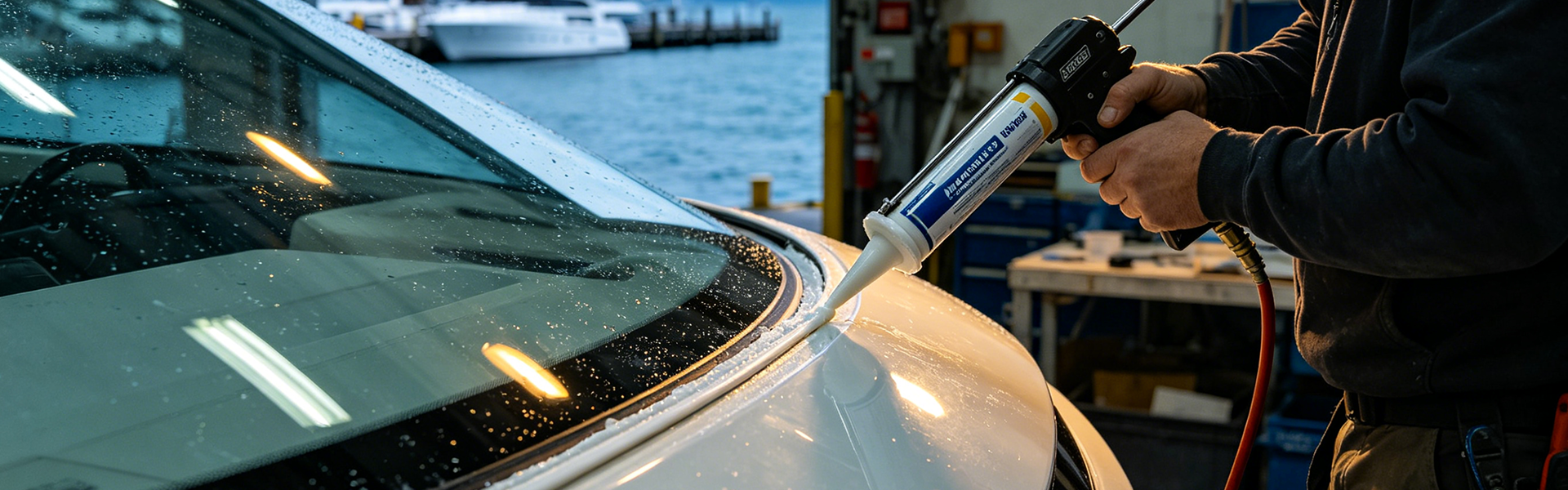
SEMITECH stocks TBT at ≥98% purity (TiO₂ 14.0–14.3%) — the workhorse Ti(IV) tetra-alkoxide catalyst for dealcoholisation-cure RTV silicone applied to copper, brass, mirror-grade glass, marble and other carbonate stones where acetic-acid byproduct from tin-cure would corrode or stain. Also widely used as transesterification catalyst for PET polymerisation. 25 kg HDPE jerrycan, 2–4 week ex-China lead time.
Contents
| 5593-70-4 | ≥98% | 14.0–14.3% |
|---|---|---|
| CAS number | Active content | TiO₂ content |
Chemistry & Specifications
Ti(IV) tetra-n-butoxide; clear pale-yellow liquid; MW 340.4; rapidly hydrolyses to TiO₂ + n-butanol on moisture exposure.
TBT — tetra-n-butyl titanate, also known as titanium tetrabutoxide or n-butyl titanate, CAS 5593-70-4 — is a tetravalent titanium alkoxide with four n-butyl groups bound to the central Ti through Ti-O-C linkages. Molecular formula C₁₆H₃₆O₄Ti, molecular weight 340.4 g/mol, density 1.00 g/cm³ at 20°C, boiling point 312°C at atmospheric pressure (decomposes), refractive index 1.487. SEMITECH supplies TBT as a clear pale-yellow to amber liquid at ≥98% active content with TiO₂ assay 14.0–14.3% by gravimetric ignition, water content ≤0.05% by Karl Fischer, and APHA colour ≤80.
The defining handling characteristic of TBT is rapid hydrolysis on contact with atmospheric moisture: each Ti-O-Bu linkage hydrolyses to Ti-OH and free n-butanol, eventually condensing to titanium dioxide hydrate. A few drops of water in a litre of TBT will cloud the liquid within minutes and drop the TiO₂ assay below specification within hours. Storage discipline (sealed under nitrogen, dry handling) is more critical for TBT than for almost any other silicone-industry catalyst. The compound is fully soluble in nearly all anhydrous organic solvents — toluene, xylene, hexane, IPA — and miscible with silicone fluids, alkyd resins, and ester monomers. It is incompatible with water, alcohols (slow exchange), carboxylic acids (forms titanium carboxylates), and primary amines.
Cure Mechanism: Lewis-Acid Catalysis of Silanol-Alkoxide Condensation with Alcohol Byproduct
Ti(IV) coordinates to silanol oxygen; ligand exchange with alkoxysilane; releases ethanol or methanol — no corrosive byproduct.
TBT operates as a Lewis-acid catalyst for silanol + alkoxysilane condensation in dealcoholisation-cure RTV silicones. The Ti(IV) centre is more oxophilic than Sn(IV) in DBTDL — it binds silanol oxygen more strongly but releases the activated complex more slowly, giving an inherently lower turnover frequency. The reaction releases methanol or ethanol byproduct (from the alkoxysilane crosslinker), forms a new Si-O-Si crosslink, and regenerates the TBT catalyst. Typical loading 0.5–2.0% on total formulation, vs 0.1% for DBTDL — reflecting the 5–10× lower intrinsic activity of titanate vs tin Lewis acidity. Tack-free time at 23°C and 50% RH for a 1.0% TBT-loaded RTV-1 alkoxy-cure sealant is 2–6 hours, full cure 5–10 days.
- Loading 0.5–1.0% — RTV-1 alkoxy-cure on copper, mirror glass, marble; long working time
- Loading 1.0–2.0% — RTV-2 condensation cast moulds for sensitive substrates
- Loading 0.05–0.20% — PET polymerisation transesterification catalyst (industrial scale)
- Loading 0.2–1.0% — alkyd-melamine and alkyd-isocyanate coating crosslinker
The killer application for TBT is dealcoholisation-cure RTV silicone on substrates that cannot tolerate acetic-acid byproduct from tin-cured oxime or acetoxy systems. Copper and brass corrode with acetic acid; mirror glass develops haze on the silvered side from acid migration; marble and limestone etch visibly within hours; some electronics (silver-plated PCBs, optical glass) fail acceptance with any acid byproduct. TBT-cured RTV releases neutral methanol or ethanol — non-corrosive, low-staining, and compliant with EU REACH for indoor air quality applications. The trade-off is cure speed (2–3× slower than tin cure at room temperature).
Applications & Formulation Guidance
Dealcoholisation-cure RTV (largest), PET polycondensation catalyst, alkyd & coating crosslinker, ink crosslinker.
Dealcoholisation-cure RTV-1 silicone sealants for copper plumbing, mirror-back installation, marble countertop bonding, and electronics encapsulation use TBT at 0.5–1.0% paired with methyltrimethoxysilane (MTMS) crosslinker and α,ω-dihydroxy-PDMS base. The neutral cure profile (methanol byproduct) prevents the acid corrosion and staining that would damage these substrates with conventional acetoxy-cure or oxime-cure RTV. RTV-2 condensation cast moulds for prototype tooling on sensitive masters (electroplated metal masters, chemically-finished wood, painted surfaces that would be marred by acetic acid) use TBT at 1.0–2.0% paired with TEOS or ethyl-silicate-40.
PET polymerisation catalysis is the volume application that drives global TBT demand — virtually all polyethylene terephthalate (PET) bottle resin and fibre is made using a titanate catalyst (TBT or its TPT/TET analogues) for the transesterification of dimethyl terephthalate with ethylene glycol, or for the polycondensation of bis(hydroxyethyl) terephthalate. Industrial PET plants dose TBT at 50–200 ppm Ti on monomer at 250–290°C; the catalyst remains in the finished PET resin at trace residual levels but is innocuous in the cured polymer. Alkyd-melamine and alkyd-isocyanate coatings use TBT at 0.2–1.0% as a crosslinking accelerator, useful in coil coatings and printing inks. Crosslinker for hydroxy-functional resins in solvent-borne and 1K coating systems uses TBT at 0.5–1.5% — useful in marine deck paint and high-build epoxy systems.
Procurement, Storage and Quality Control
CoA per shipment; 25 kg HDPE under N₂; rigorous moisture-protection; 12-month sealed shelf life.
SEMITECH issues a CoA on every batch with: TiO₂ assay (gravimetric ignition, target 14.0–14.3% — equivalent to ≥98% active TBT), water content (Karl Fischer, target ≤0.05%), APHA colour (target ≤80), density at 20°C, and refractive index. Standard packing 25 kg HDPE jerrycans under dry nitrogen blanket; 200 kg lined steel drums for bulk PET-grade orders. MOQ 25 kg per grade; bulk PET applications often order in 25 t ISO-tank container quantities. Lead time 2–4 weeks ex-Zhejiang to Asia ports, 4–6 weeks to Europe and North America after sea freight. Air freight available for laboratory and qualification quantities (1–5 kg) within 5 working days.
Moisture protection is the single most important practical issue with TBT. Each Ti-O-Bu linkage hydrolyses to Ti-OH plus n-butanol on contact with atmospheric water; even brief exposure clouds the liquid within minutes. Action: store sealed under dry nitrogen blanket below 25°C; re-blanket headspace after every draw; consume opened drums within 30 days; transfer to dispensing tanks via dry-nitrogen-purged hoses; install desiccant breathers on day-tanks. Hydrolysed TBT shows visible cloudiness and a drop in TiO₂ assay — once below 13.5%, the lot is unrecoverable for high-precision applications. Use partially-hydrolysed material for industrial RTV-2 mould rubber where exact catalyst dosing is less critical. REACH and regulatory: TBT is REACH-registered; not subject to organotin Annex XVII restrictions (no Sn). Standard food-contact compliance via FDA 21 CFR 175.300 for adhesive components; SEMITECH issues compliance statement and GHS-format SDS on every shipment. Hazards: TBT is mildly skin and eye irritant (titanate species), flammable (n-butyl alcohol byproduct on hydrolysis), and reacts violently with water in bulk quantities. Handle with nitrile gloves, chemical splash goggles, lab coat, and under positive-pressure dry-air ventilation.
TBT is the workhorse titanate catalyst — dealcoholisation cure for RTV silicone on copper, mirror, marble where tin-cure acetic-acid byproduct would corrode. Also the dominant catalyst for PET polymerisation. 25 kg HDPE under nitrogen; rigorous moisture protection; ≥98% TBT, TiO₂ 14.0–14.3%. Cure 2–3× slower than tin at 23°C — trade speed for substrate compatibility.
TBT Specification Sheet
SEMITECH stocked grade; CoA per batch.
| Property | Specification | Test Method |
|---|---|---|
| Chemical name | Tetra-n-butyl titanate / Titanium tetrabutoxide | — |
| CAS number | 5593-70-4 | — |
| Molecular formula | Ti(OC₄H₉)₄ / C₁₆H₃₆O₄Ti | — |
| Molecular weight | 340.4 g/mol | — |
| Active content | ≥98% | — |
| TiO₂ content | 14.0–14.3% | Gravimetric ignition |
| Appearance | Clear pale-yellow to amber liquid | Visual |
| Density (20°C) | 0.99–1.00 g/cm³ | ASTM D1475 |
| Refractive index (25°C) | 1.486–1.488 | ASTM D1218 |
| Boiling point | 312°C (decomposes) | — |
| Water content | ≤0.05% | Karl Fischer |
| APHA colour | ≤80 | ASTM D1209 |
| Flash point | 78°C (closed cup) | ASTM D93 |
| Solubility | Soluble in toluene, xylene, hexane, IPA; reacts with water | — |
| Packaging | 25 kg HDPE / 200 kg lined steel drum / 25 t ISO-tank | — |
| Shelf life | 12 months sealed below 25°C under N₂ | — |
FAQ
+Why does my TBT-cured RTV cure so much slower than DBTDL-cured RTV?
Lower intrinsic catalytic activity — Ti(IV) Lewis acidity is approximately 5–10× weaker than Sn(IV) for silanol activation in condensation-cure systems. A standard alkoxy-cure RTV-1 with 0.10% DBTDL gives 30–60 minute tack-free time at 23°C / 50% RH; the same formulation with 1.0% TBT (matching TiO₂ moles to Sn moles) gives 2–6 hour tack-free time. Speed-up options: (1) raise TBT to 1.5–2.0%; (2) add 0.05–0.10% chelated TET (Tyzor AA) as co-catalyst — chelation extends shelf life and improves moisture-cure kinetics; (3) raise cure temperature from 23°C to 50°C (drops cure time 3×). The slower cure is a feature, not a bug — it is the price of substrate compatibility on copper, marble, mirror, and electronics.
+Can I substitute TBT for DBTDL in my existing RTV sealant formulation?
Direct substitution requires reformulation. Specifically: (1) switch crosslinker to a clean alkoxy-functional silane (methyltrimethoxysilane MTMS or vinyltrimethoxysilane VTMS) — TBT does not work with acetoxy- or oxime-cure crosslinkers; (2) raise catalyst loading to 0.5–1.5% (vs 0.1% DBTDL); (3) qualify cure rate at customer end-use conditions — tack-free time will be 3–5× longer, full cure 1.5–2× longer; (4) verify substrate compatibility — TBT is unnecessary on plastic, painted metal, glass, concrete (DBTDL works fine on those); the substitution makes sense specifically for copper, brass, marble, mirror, and silver-plated electronics. Maintain barrier between TBT-cured production and any platinum addition-cure process; titanates do not poison Pt the way tin does, but cross-contamination is bad practice.
+How is TBT different from TPT (tetraisopropyl titanate) for PET polymerisation?
For PET polymerisation, TBT and TPT (tetraisopropyl titanate, CAS 546-68-9) are largely interchangeable — both thermally decompose at 250–290°C reactor temperatures, releasing the alcohol ligand (n-butanol from TBT, isopropanol from TPT) and depositing active TiO₂ species in the polymer melt. TBT is the dominant industry choice because: (1) lower vapour pressure of n-butanol vs isopropanol means less ligand loss to vapour-phase recovery; (2) better solubility of TBT in molten PET than TPT; (3) lower cost on a Ti-mole basis. TPT is preferred where higher reactivity at lower temperature is needed (some sol-gel processes, ink crosslinkers). For RTV silicone catalysis, TBT and TPT give very similar performance; choose by cost and supply availability.
