
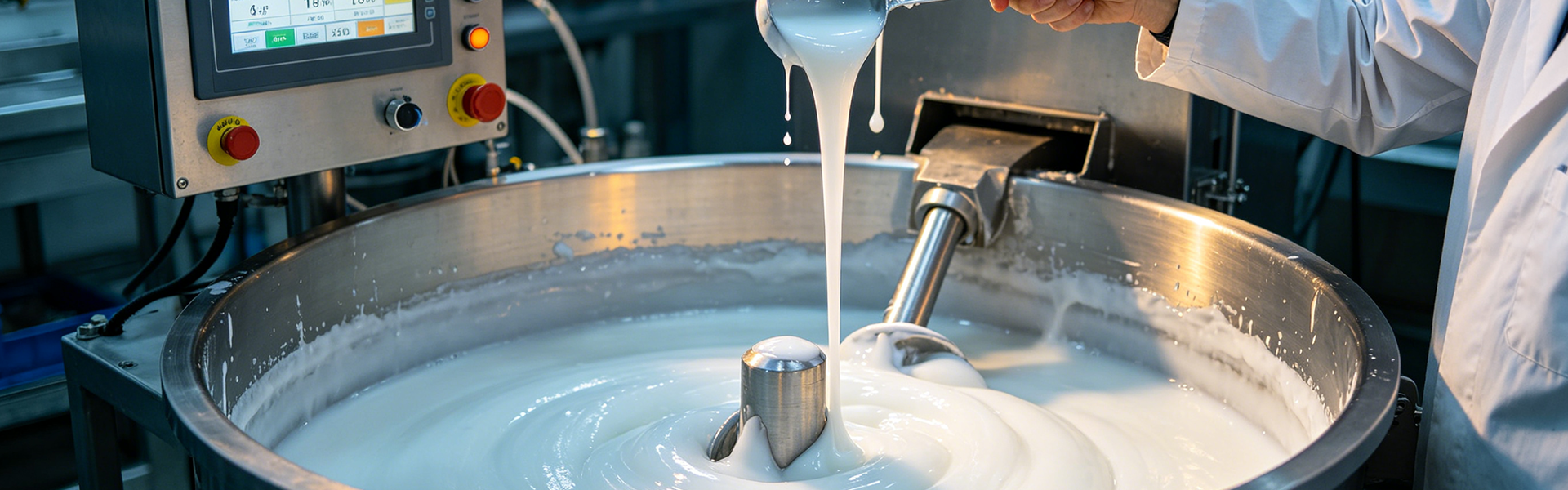
Vinyl-Terminated PDMS (α,ω-Divinyl-PDMS, CAS 68083-19-2): The Reactive Base Polymer for Addition-Cure Silicone
SEMITECH vinyl-terminated PDMS is the reactive base polymer for addition-cure silicone — α,ω-divinyl-PDMS providing the unsaturation site for Pt-catalysed crosslinking with Si-H crosslinkers. Used in LSR injection moulding, RTV-2 medical/optical, food-contact silicone, and skin-adhesive applications. Grades from 500 cP to 60,000 cP at ≥98% active vinyl. 200 kg drum / 1 t IBC.
Contents
| 68083-19-2 | 500–60,000 cP | 0.10–0.30% |
|---|---|---|
| CAS number | Viscosity range | Vinyl content |
Chemistry & Specifications
α,ω-divinyl-PDMS chain; clear colourless to pale-yellow liquid; vinyl content scaled with chain length.
Vinyl-PDMS (CAS 68083-19-2) has structure CH₂=CH-Si(CH₃)₂-O-[Si(CH₃)₂-O]ₙ-Si(CH₃)₂-CH=CH₂. Grades span 500–60,000 cP, MW 7,000–100,000 g/mol, vinyl content 0.30% (low-MW) to 0.07% (high-MW).
SEMITECH stocks five tiers: 500 cP (vinyl ~0.28%), 1,000 cP (~0.20%), 5,000 cP (~0.13%), 20,000 cP (~0.10%), 60,000 cP (~0.07%). All at ≥98% active polymer, water ≤500 ppm, APHA ≤30.
Pt-Catalysed Hydrosilylation Cure: Vinyl + Si-H Crosslinking
Vinyl group reacts with Si-H from crosslinker under Pt catalysis at 80–200°C; produces Si-CH₂-CH₂-Si network.
- 500 cP grade — low-modulus elastomer, optical encapsulation, skin-adhesive medical, soft-tissue prosthetics
- 1,000–5,000 cP — LSR injection moulding general-purpose; RTV-2 mould rubber soft-grade
- 5,000–20,000 cP — high-precision LSR moulded parts (medical, baby-care); RTV-2 medium-grade
- 20,000–60,000 cP — HCR-bridge gum, calendered sheet, high-modulus LSR for industrial sealing
Inhibitors (1-ethynyl-1-cyclohexanol, 100–500 ppm) extend pot-life to 2–4 hours at 23°C while allowing full cure at 150°C in 30 seconds. Pt poisoning by sulphur, amines, organotin, and phosphines at ppm levels is the dominant failure mode — production lines must be fully segregated from tin-cure operations.
▶Show full content (5 sections)
Applications: LSR Injection Moulding, RTV-2 Medical & Optical, Food-Contact, Skin Adhesive
LSR injection moulding (largest), RTV-2 medical/optical, food-contact silicone, optical encapsulation, skin-adhesive medical.
LSR injection moulding is the largest application — automotive seals, baby-care products, medical devices, kitchenware, electrical connectors. Vinyl-PDMS at 60–80% paired with fumed silica, PMHS crosslinker, and Karstedt Pt cures in 10–30 seconds at 150–200°C.
RTV-2 cast moulding for food-contact moulds and prototyping where faster cure and lower shrinkage are needed vs condensation cure. Optical encapsulation for LEDs and photovoltaics using chloride-free Pt chemistry. Skin-adhesive silicone using 500 cP with partial Si-H loading. Food-contact silicone — organotin-free and chloride-free chemistry meets most national food-contact regulations.
Procurement, Storage and Quality Control
CoA per shipment with vinyl content verification; 200 kg drum / 1 t IBC; 24-month shelf life; non-flammable.
MOQ 200 kg per grade. Lead time 1–2 weeks to Asia, 4–6 weeks to Europe/North America. Non-flammable (flash point >150°C); no N₂ blanket required. Shelf life 24 months sealed. Pt-poisoning prevention is critical — dedicate all transfer equipment exclusively to addition-cure production. REACH-registered; FDA 21 CFR 175.300; USP Class VI on specific grades.
Vinyl-Terminated PDMS Specification Sheet
SEMITECH stocked grades (500 / 1,000 / 5,000 / 20,000 / 60,000 cP); CoA per batch with vinyl-content verification.
| Grade | Viscosity (cP) | Vinyl % (target) | MW (typical) | Primary Application |
|---|---|---|---|---|
| VPDMS-500 | 500 ± 50 | 0.28 ± 0.02% | 7,000 g/mol | Skin-adhesive, optical, soft elastomer |
| VPDMS-1k | 1,000 ± 100 | 0.20 ± 0.02% | 15,000 g/mol | LSR general-purpose, RTV-2 soft |
| VPDMS-5k | 5,000 ± 500 | 0.13 ± 0.02% | 35,000 g/mol | LSR medical, RTV-2 medium |
| VPDMS-20k | 20,000 ± 2,000 | 0.10 ± 0.01% | 60,000 g/mol | LSR precision, RTV-2 high-modulus |
| VPDMS-60k | 60,000 ± 6,000 | 0.07 ± 0.01% | 100,000 g/mol | HCR-bridge gum, calendered sheet |
FAQ
+Which viscosity grade do I order for general-purpose LSR injection moulding?
1,000 cP or 5,000 cP. The 1,000 cP gives easier dispensing for thin-section parts; 5,000 cP gives better dimensional stability in thicker parts. Many formulations blend 60:40 to balance processability and properties.
+How do I prevent Pt poisoning in my production line?
Complete segregation: dedicated receipt area, mixing tanks, hoses, pumps, and personnel PPE for addition-cure materials. Never share equipment with tin-cure production. Regular gel-time testing of incoming batches detects contamination early.
+Can I substitute α,ω-divinyl-PDMS for vinyl-side-group PDMS?
Different properties. End-vinyl gives high elongation (300–600%) and lower modulus — typical of LSR/RTV-2. Side-group vinyl gives higher modulus (5–15 MPa) and lower elongation — typical of HCR rubber. SEMITECH stocks end-vinyl; side-group vinyl is make-to-order (4–6 weeks).