
HMDS (Hexamethyldisilazane, CAS 999-97-3): The M-Unit Silylation Reagent for Fumed Silica Surface Modification and Silicone Resin Manufacture
SEMITECH HMDS is the workhorse silylation reagent — bis(trimethylsilyl)amine — used to install trimethylsilyl (TMS) groups onto Si-OH surfaces, PDMS chain-ends, and analytical-substrate hydroxyl groups. Ammonia byproduct on use; flammable Class IB liquid; ≥99% purity, 200 kg drum, 2–4 week ex-China lead time.
Contents
| 999-97-3 | ≥99% | 161.4 |
|---|---|---|
| CAS number | Purity | MW (g/mol) |
Chemistry & Specifications
Bis(trimethylsilyl)amine, (Me₃Si)₂NH; clear colourless liquid; bp 125°C; ammonia byproduct; flammable.
HMDS (CAS 999-97-3) has structure (CH₃)₃Si–NH–Si(CH₃)₃, MW 161.4 g/mol, density 0.774 g/cm³, bp 125°C, flash point 19°C. SEMITECH supplies at ≥99% purity by GC, water ≤500 ppm, free trimethylsilanol ≤0.5%, APHA ≤30.
One mole of HMDS silylates two moles of substrate-OH, releasing one mole of ammonia. The ammonia byproduct must be vented or scrubbed during industrial-scale silylation.
Applications: Silica Surface Modification, MQ Resin, GC Derivatisation, Semiconductor
Fumed silica hydrophobisation, MQ resin synthesis, analytical GC derivatisation, semiconductor photolithography adhesion.
Fumed silica hydrophobic surface modification is the largest application — converting hydrophilic fumed silica to hydrophobic for use in silicone sealants, defoamer compounds, and inks. Dosed at 5–15 wt% on silica in a fluidised-bed reactor at 80–150°C.
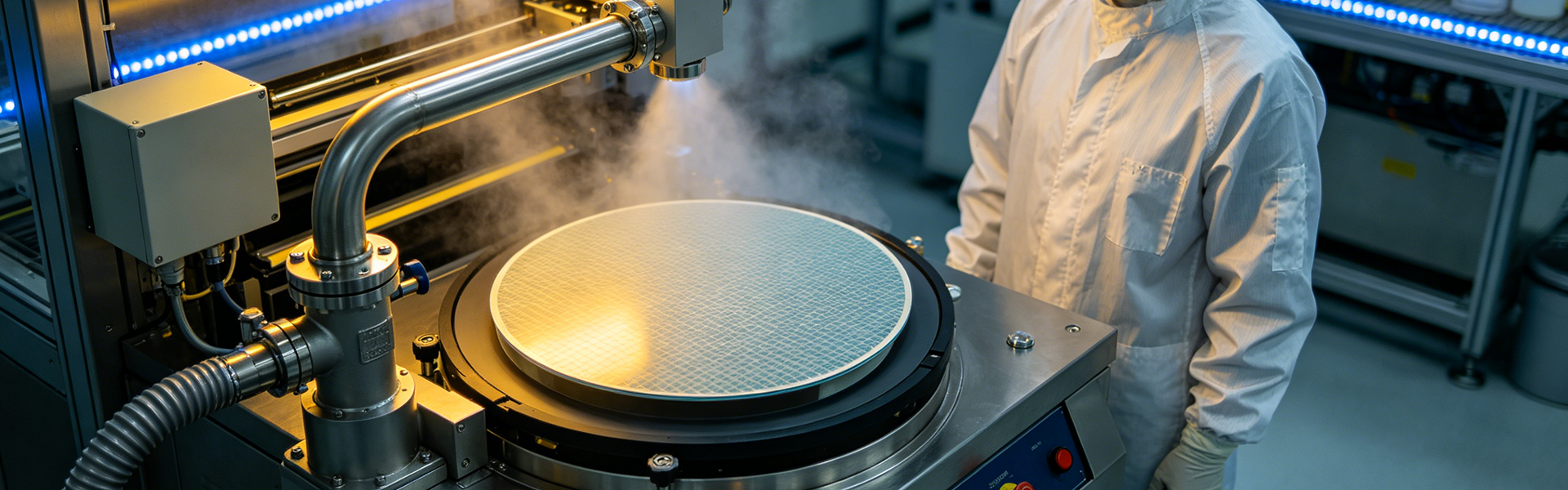
MQ silicone resin synthesis uses HMDS as the M-unit source paired with TEOS as Q-unit in cohydrolysis-condensation. Analytical GC derivatisation converts polar analytes into volatile TMS derivatives. Semiconductor photolithography uses HMDS vapour as adhesion promoter on silicon wafers before photoresist coating. PDMS chain-end capping installs TMS groups on OH-terminated PDMS.
▶Show full content (5 sections)
Reaction Mechanism, Ammonia Byproduct, and Industrial Handling
TMS-N-TMS attacks substrate-OH; releases NH₃; full silylation requires venting/scrubbing.
Reaction kinetics are favoured by elevated temperature (80–150°C), acid catalysis (0.1–1.0%), and anhydrous conditions.
- Fumed silica silylation — 5–15 wt% HMDS on silica, 80–150°C, 1–4 hr in fluidised bed or stirred tank with N₂ purge for NH₃ removal
- MQ resin synthesis — HMDS as M-unit, TEOS as Q-unit, cohydrolysis at 60–120°C with acid catalyst
- GC derivatisation — HMDS at 5–10 mol equivalents on analyte, 60–80°C, 30–60 min in pyridine solvent
- Semiconductor photolithography — HMDS vapour at 100–150°C, 1–2 minute wafer treatment in dedicated HMDS vapour-prime tool
An ammonia scrubber (sulphuric acid or citric acid solution) is required for any HMDS use generating >1 kg NH₃ per day. Industrial plants typically achieve 95%+ HMDS utilisation through closed-loop NH₃ scrubbing and HMDSO recovery.
Procurement, Storage and Quality Control
CoA per shipment; 200 kg drum; 12-month shelf life; flash point 19°C — Class IB flammable, requires segregation.
Standard packing 200 kg HDPE-lined steel drums; 1 t IBC totes for high-volume users; 25 kg amber glass bottles for lab-scale. MOQ 200 kg, lead time 2–4 weeks ex-Zhejiang to Asia, 4–6 weeks to Europe/North America (Class IB flammable DG shipment).
Storage at 5–25°C with positive ventilation and explosion-proof fittings. Shelf life 12 months sealed under N₂ below 25°C. REACH-registered; SDS in EU/GHS format.
HMDS Specification Sheet
SEMITECH stocked grade; CoA per batch.
| Property | Specification | Test Method |
|---|---|---|
| Chemical name | Hexamethyldisilazane / Bis(trimethylsilyl)amine | — |
| CAS number | 999-97-3 | — |
| Molecular formula | (CH₃)₃Si-NH-Si(CH₃)₃ / C₆H₁₉NSi₂ | — |
| Molecular weight | 161.4 g/mol | — |
| Purity (HMDS) | ≥99% | Gas chromatography |
| Water content | ≤500 ppm | Karl Fischer |
| Free trimethylsilanol | ≤0.5% | GC |
| APHA colour | ≤30 | ASTM D1209 |
| Density (20°C) | 0.774 g/cm³ | ASTM D1475 |
| Refractive index (20°C) | 1.408 | ASTM D1218 |
| Boiling point | 125°C (atmospheric) | — |
| Flash point | 19°C (closed cup) | ASTM D93 |
| Vapour pressure (20°C) | 1.5 kPa (~11 mmHg) | — |
| Flammability classification | Class IB / EU CLP Flammable Liquid Cat. 2 | — |
| Reactivity | Reacts with water releasing NH₃ + (CH₃)₃SiOH | — |
| Packaging | 200 kg HDPE-lined steel drum / 1 t IBC / 25 kg amber glass for lab | — |
| Shelf life | 12 months sealed below 25°C under N₂ | — |
FAQ
+How much HMDS do I need to fully hydrophobise fumed silica with 200 m²/g surface area?
Theoretical minimum is ~10.8 wt% HMDS on silica (based on 4 OH/nm² silanol density). Practical industrial loading is 12–15 wt% to push conversion above 90%. For lower-surface-area silica (50–100 m²/g), reduce to 5–8 wt%.
+Can I substitute HMDSO (hexamethyldisiloxane) for HMDS as a silylation reagent?
No — HMDSO is the stable byproduct of HMDS silylation with no Si-N bond and no silylation reactivity. To install TMS groups you need an Si-N or Si-Cl reagent: HMDS (preferred for silica), TMSCl (more aggressive, releases HCl), or BSA (gentler for analytical chemistry).
+How do I manage the ammonia byproduct in industrial-scale fumed silica silylation?
Vent the reactor headspace through a packed-bed scrubber containing 5–10% sulphuric acid or citric acid solution. Each kg HMDS releases 0.105 kg NH₃ at full conversion. Scale scrubber capacity with 1.5–2× safety factor.