
SEMITECH
Silicone Intermediates

HMDS Hexamethyldisilazane

HMDS — hexamethyldisilazane, also written as bis(trimethylsilyl)amine or 1,1,1,3,3,3-hexamethyldisilazane, CAS 999-97-3 — is a silylation reagent with the structure (CH₃)₃Si–NH–Si(CH₃)₃. Molecular formula C₆H₁₉NSi₂, mole

HMDS (Hexamethyldisilazane, CAS 999-97-3): The M-Unit Silylation Reagent for Fumed Silica Surface Modification and Silicone Resin Manufacture

SEMITECH HMDS is the workhorse silylation reagent — bis(trimethylsilyl)amine — used to install trimethylsilyl (TMS) groups onto Si-OH surfaces (fumed silica hydrophobisation), Si-OH polymer chain-ends (PDMS endcapping), and analytical-substrate hydroxyl groups (GC derivatisation). Ammonia byproduct on use; flammable Class IB liquid; ≥99% purity, 200 kg drum, 2–4 week ex-China lead time.

Contents

999-97-3≥99%161.4
CAS numberPurityMW (g/mol)

Chemistry & Specifications

Bis(trimethylsilyl)amine, (Me₃Si)₂NH; clear colourless liquid; bp 125°C; ammonia byproduct; flammable.

HMDS — hexamethyldisilazane, also written as bis(trimethylsilyl)amine or 1,1,1,3,3,3-hexamethyldisilazane, CAS 999-97-3 — is a silylation reagent with the structure (CH₃)₃Si–NH–Si(CH₃)₃. Molecular formula C₆H₁₉NSi₂, molecular weight 161.4 g/mol, density 0.774 g/cm³ at 20°C, refractive index 1.408, boiling point 125°C at atmospheric pressure, flash point 19°C closed cup. SEMITECH supplies HMDS as a clear colourless mobile liquid at ≥99% purity by GC, with water content ≤500 ppm (HMDS is moisture-sensitive but more tolerant than alkoxysilanes), free trimethylsilanol ≤0.5%, and APHA colour ≤30. The compound has a strong characteristic ammonia odour from trace decomposition; full odour will be released on contact with moisture and acidic surfaces during silylation reactions.

HMDS functions as a “silylation reagent” — its purpose is to install trimethylsilyl (TMS, –Si(CH₃)₃) groups onto reactive hydroxyl, amine, or carboxyl groups on a target substrate, replacing the H of those functional groups with the TMS group. The mechanism: HMDS reacts with substrate-OH (for example, on the surface of fumed silica or at the chain-end of α,ω-dihydroxy-PDMS) to form substrate-O-Si(CH₃)₃ + (CH₃)₃Si-NH₂; the trimethylsilylamine intermediate further reacts with another substrate-OH to form a second substrate-O-Si(CH₃)₃ + ammonia. Net stoichiometry: one mole of HMDS silylates two moles of substrate-OH, releasing one mole of ammonia. The ammonia byproduct must be vented or scrubbed during industrial-scale silylation operations.

Applications: Silica Surface Modification, MQ Resin, GC Derivatisation, Semiconductor

Fumed silica hydrophobisation, MQ resin synthesis, analytical GC derivatisation, semiconductor photolithography adhesion.

Fumed silica hydrophobic surface modification is the largest single application — converting hydrophilic fumed silica (surface Si-OH) to hydrophobic fumed silica (surface Si-O-Si(CH₃)₃) for use as a thickening, anti-sag, and rheology-modifying additive in non-aqueous formulations like silicone sealants, defoamer compounds, polyester moulding compound, and inks. Fumed silica producers dose HMDS at 5–15 wt% on silica weight in a fluidised-bed reactor or stirred-tank silylation reactor, typically at 80–150°C for 1–4 hours, achieving 90–99% conversion of surface silanol to TMS. SEMITECH supplies approximately 8–12% of global HMDS demand for this application.

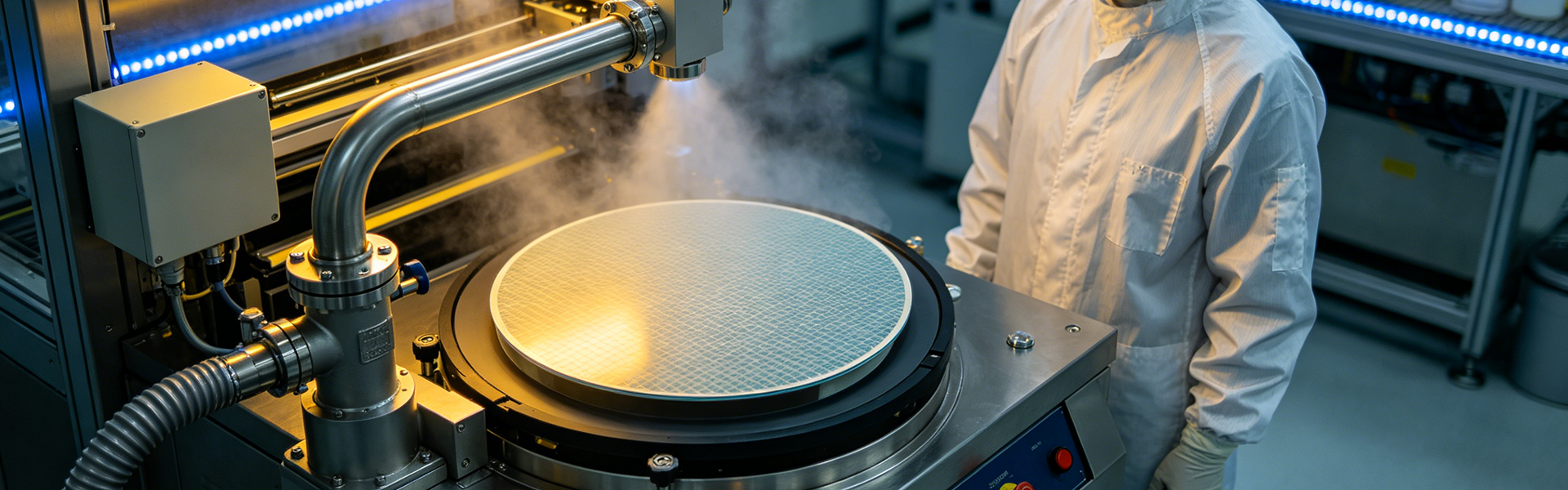
MQ silicone resin synthesis uses HMDS as the M-unit (mono-functional trimethylsilyl) source paired with TEOS as the Q-unit (tetra-functional silicate) source — in the cohydrolysis-condensation reaction, HMDS provides the chain-terminating TMS groups that control molecular weight and processing characteristics of the finished MQ resin. Typical M:Q ratio in MQ resins is 0.6–1.0 by mole. Analytical GC derivatisation uses HMDS as a silylation reagent to convert polar, non-volatile analyte hydroxyl groups (sugars, alcohols, organic acids, amines) into volatile TMS-derivatised analogues for gas chromatography analysis. Semiconductor photolithography uses HMDS as an adhesion promoter — the silicon wafer surface is exposed to HMDS vapour before photoresist coating to convert surface Si-OH (oxide) to surface Si-O-Si(CH₃)₃, providing the hydrophobic surface needed for uniform photoresist adhesion. PDMS chain-end capping uses HMDS to install TMS groups on α,ω-dihydroxy-PDMS chain ends, converting the OH-terminated polymer into a chain-end-capped methyl-terminated PDMS for applications where moisture-cure reactivity is undesirable.

Reaction Mechanism, Ammonia Byproduct, and Industrial Handling

TMS-N-TMS attacks substrate-OH; releases NH₃; full silylation requires venting/scrubbing.

The silylation reaction proceeds via nucleophilic attack of substrate-OH on the Si-N bond of HMDS, displacing one TMS group as TMS-substrate ester and producing TMS-NH₂ as intermediate. The TMS-NH₂ further reacts with a second substrate-OH, displacing the second TMS group and releasing NH₃ as the final byproduct. Reaction kinetics are favoured by: (1) elevated temperature (80–150°C drops reaction time from hours to minutes); (2) acid catalysis (trace TFA, p-TSA at 0.1–1.0% accelerates the kinetics 5–10×); (3) anhydrous conditions (water competes with substrate-OH and consumes HMDS without productive silylation).

  • Fumed silica silylation — 5–15 wt% HMDS on silica, 80–150°C, 1–4 hr in fluidised bed or stirred tank with N₂ purge for NH₃ removal
  • MQ resin synthesis — HMDS as M-unit, TEOS as Q-unit, cohydrolysis at 60–120°C with acid catalyst
  • GC derivatisation — HMDS at 5–10 mol equivalents on analyte, 60–80°C, 30–60 min in pyridine solvent
  • Semiconductor photolithography — HMDS vapour at 100–150°C, 1–2 minute wafer treatment in dedicated HMDS vapour-prime tool

Ammonia management is the dominant industrial-handling consideration — an ammonia scrubber (sulphuric acid solution, citric acid solution) is required for any HMDS use generating >1 kg NH₃ per day. The TMS-OH (trimethylsilanol) byproduct of partial reactions condenses to hexamethyldisiloxane (HMDSO, CAS 107-46-0) which is a useful low-boiling silicone fluid that can be recovered and recycled. Industrial fumed silica silylation plants typically achieve 95%+ HMDS utilisation through closed-loop NH₃ scrubbing and HMDSO recovery.

Procurement, Storage and Quality Control

CoA per shipment; 200 kg drum; 12-month shelf life; flash point 19°C — Class IB flammable, requires segregation.

SEMITECH issues a CoA on every batch with: HMDS purity (GC, target ≥99%), water content (Karl Fischer, target ≤500 ppm), free trimethylsilanol content (GC, target ≤0.5%), APHA colour (target ≤30), density at 20°C, refractive index, and flash point. Standard packing 200 kg HDPE-lined steel drums; 1 t IBC totes for high-volume fumed silica producers and MQ resin manufacturers; 25 kg amber glass bottles for laboratory-scale GC derivatisation customers. MOQ 200 kg per order for industrial use, 1 kg for laboratory samples. Lead time 2–4 weeks ex-Zhejiang to Asia ports, 4–6 weeks to Europe and North America after sea freight (Class IB flammable shipment requires reefer container or expedited DG processing).

Storage: HMDS has flash point 19°C — Class IB flammable liquid (low flash point, vapour ignites at room temperature with ignition source). Storage requirements: dedicated flammable-storage cabinet or warehouse area at 5–25°C with positive ventilation and explosion-proof electrical fittings; ground all transfer equipment; no open flames within 10 metres of transfer operations; spill containment for full drum capacity; HMDS-specific spill kit with neutraliser (5% citric acid solution) on site. Shelf life 12 months sealed under nitrogen blanket below 25°C; opened drums should be re-blanketed and consumed within 90 days. Health and reactivity: HMDS is a flammable, mild skin-and-eye irritant; ammonia byproduct on contact with moisture is acutely irritant to respiratory system; full PPE — chemical-splash goggles, nitrile gloves, lab coat, respirator (P95 minimum); only handle in a well-ventilated fume hood. Spill response: cool with water to prevent ignition (do not contact directly with water at high concentration — exothermic ammonia release possible), absorb on inert media, neutralise residue with 5% citric acid solution, dispose as flammable + ammonia hazardous waste. REACH and regulatory: REACH-registered for industrial use; SDS in EU/GHS format with full flammability and ammonia-byproduct classification.

HMDS is the workhorse silylation reagent — installs trimethylsilyl groups on Si-OH surfaces. Largest application is fumed silica hydrophobisation (5–15 wt% on silica). Class IB flammable (flash point 19°C) requires dedicated DG storage. Ammonia scrubber required for industrial-scale silylation. ≥99% purity, 200 kg drum, 12-month shelf life under N₂.

HMDS Specification Sheet

SEMITECH stocked grade; CoA per batch.

PropertySpecificationTest Method
Chemical nameHexamethyldisilazane / Bis(trimethylsilyl)amine
CAS number999-97-3
Molecular formula(CH₃)₃Si-NH-Si(CH₃)₃ / C₆H₁₉NSi₂
Molecular weight161.4 g/mol
Purity (HMDS)≥99%Gas chromatography
Water content≤500 ppmKarl Fischer
Free trimethylsilanol≤0.5%GC
APHA colour≤30ASTM D1209
Density (20°C)0.774 g/cm³ASTM D1475
Refractive index (20°C)1.408ASTM D1218
Boiling point125°C (atmospheric)
Flash point19°C (closed cup)ASTM D93
Vapour pressure (20°C)1.5 kPa (~11 mmHg)
Flammability classificationClass IB / EU CLP Flammable Liquid Cat. 2
ReactivityReacts with water releasing NH₃ + (CH₃)₃SiOH
Packaging200 kg HDPE-lined steel drum / 1 t IBC / 25 kg amber glass for lab
Shelf life12 months sealed below 25°C under N₂

FAQ

+How much HMDS do I need to fully hydrophobise fumed silica with 200 m²/g surface area?

Theoretical stoichiometry: surface silanol density on fumed silica is approximately 4 OH/nm² (typical), translating to 1.3 mmol Si-OH per gram of 200 m²/g silica. Each HMDS molecule silylates 2 Si-OH groups, so theoretical minimum is 0.67 mmol HMDS = 0.108 g HMDS per gram of silica = 10.8 wt% HMDS on silica. Practical industrial loading is 12–15 wt% to ensure 90%+ silanol conversion (the silylation kinetics slow as remaining silanol density drops, so excess HMDS is needed to push conversion above 90%). For lower-surface-area silica (50–100 m²/g, e.g., precipitated silica), reduce loading to 5–8 wt%. Engineer-scale dosing should be confirmed by carbon-content analysis of the silylated silica (typical target 1.5–2.5% C indicates full silylation).

+Can I substitute HMDSO (hexamethyldisiloxane) for HMDS as a silylation reagent?

No — HMDSO (hexamethyldisiloxane, (CH₃)₃Si-O-Si(CH₃)₃, CAS 107-46-0) is the byproduct of HMDS silylation, not a silylation reagent. HMDSO is a stable, low-boiling silicone fluid with no Si-N bond and no silylation reactivity. Common confusion comes from the similar names. To install TMS groups on a Si-OH surface, you specifically need an Si-N or Si-Cl reagent: HMDS (preferred for industrial silica hydrophobisation), TMSCl (trimethylchlorosilane, more aggressive but releases HCl), or BSA (bis(trimethylsilyl)acetamide, gentler for analytical chemistry). For most silica-modification applications, HMDS is the right choice.

+How do I manage the ammonia byproduct in industrial-scale fumed silica silylation?

NH₃ scrubbing is mandatory for any HMDS use generating >1 kg NH₃ per day. Standard configuration: vent the silylation reactor headspace through a packed-bed scrubber containing 5–10% sulphuric acid solution (or citric acid for less corrosive operation) to absorb NH₃ as (NH₄)₂SO₄ or ammonium citrate. The scrubber liquor is treated as low-pH wastewater for downstream wastewater treatment (typically combined with other plant streams for pH neutralisation before biological treatment). Industrial fumed silica silylation plants achieve 95%+ NH₃ capture efficiency and recover the (NH₄)₂SO₄ as a sellable agricultural fertiliser byproduct. Scale your scrubber capacity for the maximum HMDS feed rate (each kg HMDS releases 0.105 kg NH₃ at full conversion) plus a safety factor of 1.5–2× for upset conditions.

03 / Inquiry

Enquire about HMDS Hexamethyldisilazane.

Submit your technical requirements and volume. A SEMITECH specialist will recommend the right spec and arrange sample shipment.

Reply
24hrs
Sample
5days

Your information is used only to respond to your inquiry and will not be shared.

TelegramWhatsApp