
SEMITECH
Silicone Intermediates

Fluorosilicone Fluid (FMVQ)

Fluorosilicone fluid — also called methyl trifluoropropyl polysiloxane, ASTM designation FMVQ (fluorovinylmethylsiloxane in vulcanised form), is a polysiloxane where the methyl groups on alternate silicon atoms are repla

Fluorosilicone Fluid (Methyl Trifluoropropyl Polysiloxane, FMVQ): Fuel-Resistant and Solvent-Resistant Silicone for Aerospace and Industrial Applications

SEMITECH fluorosilicone fluid is the fuel-and-solvent-resistant silicone — methyl trifluoropropyl polysiloxane (FMVQ designation) with trifluoropropyl groups replacing the methyl on alternate silicons. Provides 80–95% volume retention in jet fuel, hydraulic fluid, and aromatic solvents where standard PDMS swells 200–400%. Specialty grade for aerospace fuel system O-rings, military-spec gaskets, and chemical-process seals. 25 kg HDPE / 200 kg drum.

Contents

FMVQ5–15% swell100–60,000 cP
ASTM designationIn jet fuelViscosity range

Chemistry & Specifications

Methyl trifluoropropyl polysiloxane; pale-yellow viscous liquid; CF₃ groups provide fuel/solvent resistance.

Fluorosilicone fluid — also called methyl trifluoropropyl polysiloxane, ASTM designation FMVQ (fluorovinylmethylsiloxane in vulcanised form), is a polysiloxane where the methyl groups on alternate silicon atoms are replaced by 3,3,3-trifluoropropyl groups (–CH₂-CH₂-CF₃). The polymer structure is typically [-Si(CH₃)(CH₂CH₂CF₃)-O-]ₙ, where the alternation between methyl-only and methyl-trifluoropropyl silicons provides the optimal balance of fluorine content for fuel resistance vs polymer flexibility for elastomer properties. Typical fluorine content is 35–37% by weight.

SEMITECH supplies fluorosilicone fluid in five viscosity tiers: 100 cP, 1,000 cP, 10,000 cP, 30,000 cP, 60,000 cP at 25°C. CoA verification: fluorine content (X-ray fluorescence, target 35.0–37.0%), viscosity at 25°C (Brookfield, target ±10%), water content (Karl Fischer, target ≤500 ppm), volatile content (D4F/D5F cyclic fluorosiloxane residue, GC, target ≤2%), APHA colour (target ≤50; the slight yellow tint is characteristic of fluorosilicone and not a defect). The polymer is a pale-yellow to amber viscous liquid with density 1.20–1.25 g/cm³ (significantly higher than standard PDMS at 0.97 g/cm³ due to fluorine mass), refractive index 1.385, and flash point >250°C. Fluorosilicone is fully soluble in fluorinated solvents (HFE, perfluoroalkanes, PFPE), partially miscible with hydrocarbons (sufficient for blending into hydrocarbon-based formulations), and largely immiscible with standard PDMS — limiting blendability with regular silicone systems.

Fuel and Solvent Resistance: Why FMVQ Replaces PDMS

Trifluoropropyl groups provide hydrophobic, oleophobic, fluorophilic surface — minimal swelling in jet fuel, hydraulic fluid, aromatics.

Standard methyl silicone (PDMS) swells dramatically in fuel and solvent environments — 200–400% volume swell in jet fuel (Jet-A, JP-4), 150–300% in hydraulic fluid (MIL-H-83282, Skydrol), 300–500% in aromatic solvents (toluene, xylene). The methyl groups along the PDMS backbone are oleophilic — the long-chain hydrocarbons of fuel and the aromatic ring of solvents partition into the silicone matrix, swelling and softening it until the elastomer fails mechanically.

Trifluoropropyl groups in fluorosilicone are simultaneously hydrophobic (do not absorb water), oleophobic (do not absorb hydrocarbons), and fluorophilic (do absorb fluorinated solvents). The –CF₃ end of each side chain creates a low-surface-energy, fluorine-rich surface that resists wetting and partitioning by hydrocarbon fluids. Result: typical fluorosilicone elastomer in Jet-A jet fuel shows 5–15% volume swell after 168 hours at 70°C (versus 250–350% swell for PDMS); in hydraulic fluid 8–18% (vs 200–280%); in toluene 15–25% (vs 400–500%). The dramatic improvement in fuel/solvent resistance is what makes fluorosilicone the mandatory specification for aerospace fuel system seals, military-spec gaskets, and chemical-process equipment seals.

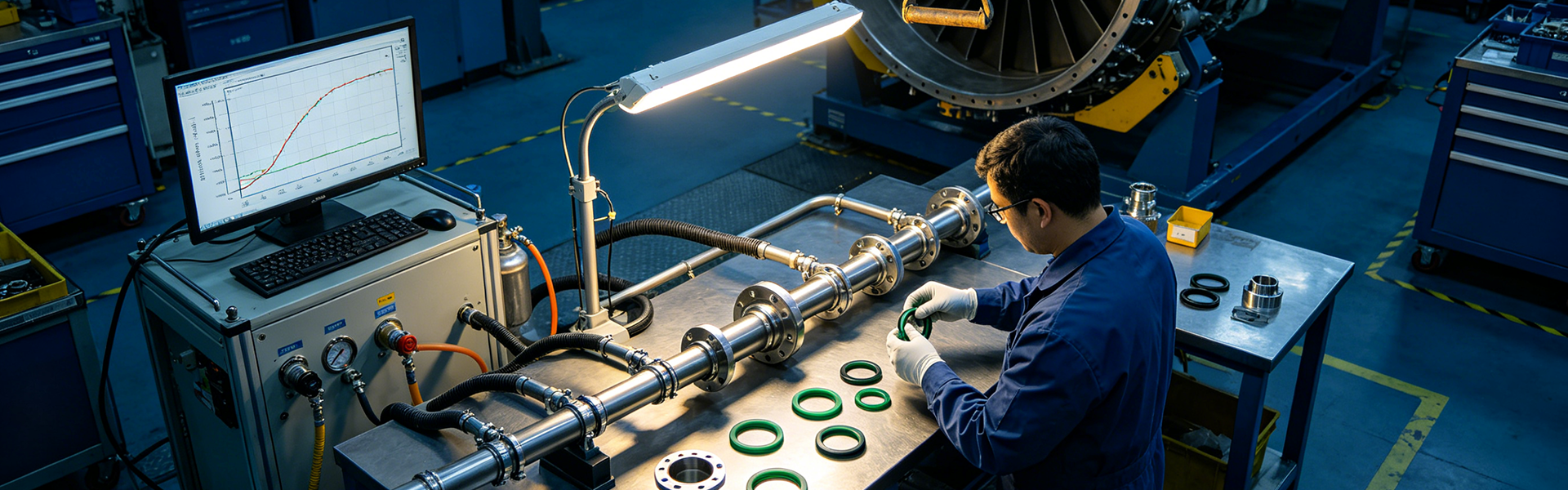
  • Aerospace fuel system O-rings — Jet-A and JP-8 fuel resistance per AMS 7257, MIL-DTL-25988
  • Military-spec gaskets — hydraulic fluid + skydrol resistance for combat aircraft and defence vehicles
  • Chemical-process seals — aromatic solvent and chlorinated solvent resistance for petrochemical and pharmaceutical equipment
  • Automotive fuel injection — modern direct-injection gasoline systems with ethanol-blended fuel

Applications: Aerospace, Military, Automotive Fuel System, Chemical Process

Aerospace fuel system seals (largest), military hydraulic seals, automotive fuel injection, chemical process equipment seals.

Aerospace fuel system seals are the dominant application — O-rings, gaskets, fuel pump diaphragms, and engine fuel control unit seals in commercial and military aircraft fuel systems. Fluorosilicone elastomer compounded from FMVQ fluid base, fumed silica reinforcement, and Pt or peroxide cure system meets AMS 7257, MIL-DTL-25988, and equivalent international aerospace specifications. The combination of fuel resistance, low-temperature flexibility (operational to −55°C in flight), and high-temperature stability (operational to +175°C in engine compartment) is uniquely met by fluorosilicone — fluoroelastomer (FKM) competes on fuel resistance but lacks low-temperature flexibility; standard silicone (VMQ) competes on temperature range but lacks fuel resistance.

Military hydraulic and fuel system seals use fluorosilicone for combat aircraft, naval vessels, and ground vehicles where simultaneous fuel resistance and arctic-environment low-temperature flexibility are required. Automotive fuel injection seals in modern direct-injection gasoline engines use fluorosilicone where ethanol-blended fuels (E10, E85) attack standard hydrocarbon-based elastomers. Chemical-process equipment seals in pharmaceutical, petrochemical, and food-processing facilities use fluorosilicone where aromatic solvents (toluene, xylene), chlorinated solvents (DCM, chloroform), and fluorinated solvents (HFE) are present in the process stream. Specialty applications: laser optical equipment seals (where outgassing of hydrocarbons would contaminate optics); semiconductor equipment seals (corrosive process gas resistance); deep-sea and offshore subsea seals (combined hydrocarbon + saltwater resistance).

Procurement, Storage and Quality Control

CoA per shipment; 25 kg HDPE / 200 kg drum; 24-month shelf life; non-flammable; cost premium ~5–8x methyl silicone.

SEMITECH issues a CoA on every batch with: fluorine content (X-ray fluorescence, target 35.0–37.0%), viscosity at 25°C (Brookfield, target ±10% of grade specification), volatile fluorocyclic content (D4F/D5F by GC, target ≤2%), water content (Karl Fischer, target ≤500 ppm), APHA colour (target ≤50), density at 25°C, and refractive index. Standard packing 25 kg HDPE jerrycans for laboratory and small-volume customers; 200 kg HDPE-lined steel drums for production-scale aerospace and automotive seal manufacturers; 1 t IBC totes for high-volume customers (rare for fluorosilicone). MOQ 25 kg per grade. Lead time 4–6 weeks ex-Zhejiang to Asia ports for stocked grades, 6–8 weeks to Europe and North America after sea freight.

Storage: stable under ambient conditions; non-flammable (flash point >250°C); no nitrogen blanket required. Recommended: store sealed below 30°C in original packaging. Shelf life 24 months sealed; opened drums consumable within 12 months without significant fluorine-content drift. Cost positioning: fluorosilicone fluid Q1 2026 ex-Zhejiang spot CNY 180,000–250,000/MT (USD 25–35/kg) — 5–8× the cost of standard methyl silicone fluid (CNY 25,000–40,000/MT). The cost premium reflects the fluoromonomer (3,3,3-trifluoropropyl methyl dichlorosilane is the key feedstock, produced at limited scale globally) and the specialty production capacity required (fluorosilicone polymerisation requires segregated reactors due to cross-contamination concerns with methyl silicone). Reservation: aerospace and military supply contracts typically lock in 6–12 month forward pricing to manage supply-chain volatility. Health and regulatory: REACH-registered for industrial use; not subject to PFAS-broader regulatory restrictions (the trifluoropropyl group is short-chain fluorocarbon and not classified as long-chain PFAS); standard mineral oil + PDMS toxicology profile; mild skin and eye irritant; standard PPE — nitrile gloves, splash goggles. SDS in EU/GHS format issued with every shipment with full PFAS-classification clarification.

Fluorosilicone fluid is the fuel-and-solvent-resistant specialty silicone — trifluoropropyl groups provide 80–95% volume retention in jet fuel, hydraulic fluid, and aromatic solvents where PDMS swells 200–400%. Mandatory for aerospace fuel system seals, military hydraulic gaskets, automotive ethanol-fuel injection. 5–8× cost premium over methyl silicone justifies use only where fuel resistance is required.

Fluorosilicone Fluid Specification Sheet

SEMITECH stocked grades (100 / 1k / 10k / 30k / 60k cP); CoA per batch with fluorine-content verification.

PropertySpecificationTest Method
Chemical nameMethyl trifluoropropyl polysiloxane (FMVQ)
Polymer structure[-Si(CH₃)(CH₂CH₂CF₃)-O-]ₙ
Fluorine content35.0–37.0%X-ray fluorescence
Viscosity grades100 / 1,000 / 10,000 / 30,000 / 60,000 cPBrookfield at 25°C
Volatile fluorocyclic content≤2%GC
Water content≤500 ppmKarl Fischer
APHA colour≤50ASTM D1209
Density (25°C)1.20–1.25 g/cm³ASTM D1475
Refractive index (25°C)1.385ASTM D1218
Flash point>250°C (closed cup)ASTM D93
Service temperature−55°C to +175°C continuous
Jet fuel volume swell (168 hr at 70°C)5–15%ASTM D471
Hydraulic fluid swell8–18%ASTM D471
Solubility in fluorinated solventsFully miscible
Solubility in hydrocarbonsPartially miscible
Solubility in PDMSLargely immiscible
Packaging25 kg HDPE jerrycan / 200 kg drum / 1 t IBC
Shelf life24 months sealed below 30°C

FAQ

+Is fluorosilicone fluid affected by the EU PFAS restrictions?

Fluorosilicone fluid is NOT classified as long-chain PFAS under current EU REACH PFAS framework. The trifluoropropyl group (–CH₂CH₂CF₃) contains only one terminal CF₃ and falls outside the C8+ perfluoroalkyl chain definition that drives the PFAS Restriction proposal. Industrial use of fluorosilicone in aerospace, automotive, and chemical-process applications remains permitted under REACH. However, the broader PFAS regulatory landscape is evolving — ECHA and member-state regulatory bodies have signaled potential expansion of PFAS scope to include shorter-chain fluorocarbons in 2026–2030. SEMITECH monitors regulatory developments and provides updated SDS classification with each shipment. For aerospace and defence customers, the regulatory clarity that fluorosilicone is currently exempt is part of the supply-decision framework — engaging with REACH consultancy specific to your downstream-product compliance pathway is recommended for long-term planning.

+Can I substitute fluorosilicone for FKM (Viton) in fuel-resistant seal applications?

Different chemistry, different property profile — both are fuel-resistant elastomers but with distinct strengths. Fluorosilicone (FMVQ) advantages: low-temperature flexibility to −55°C (FKM cracks below −20°C), broader temperature range (−55°C to +175°C continuous vs −20°C to +200°C for FKM), better high-temperature elastic recovery. FKM advantages: lower volume swell in fuel (1–5% in jet fuel vs 5–15% for fluorosilicone), better aromatic solvent resistance, lower cost per kg of finished elastomer (FKM compound USD 15–25/kg vs fluorosilicone USD 30–50/kg). Application fit: fluorosilicone for aerospace seals where low-temperature flexibility is critical (high-altitude flight at −40 to −55°C); FKM for ground-based fuel system seals where the operating temperature range stays above −20°C and tighter swell control is required. Many aerospace fuel system applications specify both materials in different locations of the same fuel system based on local thermal profile.

+How is fluorosilicone fluid converted to a fuel-resistant elastomer for production sealing?

Fluorosilicone elastomer is compounded from FMVQ base fluid + reinforcing filler + cure system, similar to standard silicone elastomer compounding. Typical formulation: fluorosilicone fluid (60–70%) + fumed silica reinforcing filler (15–25%) + processing aid + Pt catalyst (for addition cure) or peroxide (for radical cure). Fluorosilicone-specific filler is required — standard hydrophilic fumed silica and most standard hydrophobic silicas have surface chemistry incompatible with the fluorocarbon polymer; specialised fluorinated-silica or carbon-black filler at 15–25% provides the reinforcement. Cured fluorosilicone elastomer (FMVQ vulcanisate) typical Shore A hardness 50–80, tensile 8–14 MPa, elongation 200–400%. Compound formulation is project-specific to the seal geometry, operating conditions, and cure cycle of the customer’s production line — engage SEMITECH technical service for starting-point formulations and technical-development support.

03 / Inquiry

Enquire about Fluorosilicone Fluid (FMVQ).

Submit your technical requirements and volume. A SEMITECH specialist will recommend the right spec and arrange sample shipment.

Reply
24hrs
Sample
5days

Your information is used only to respond to your inquiry and will not be shared.

TelegramWhatsApp