
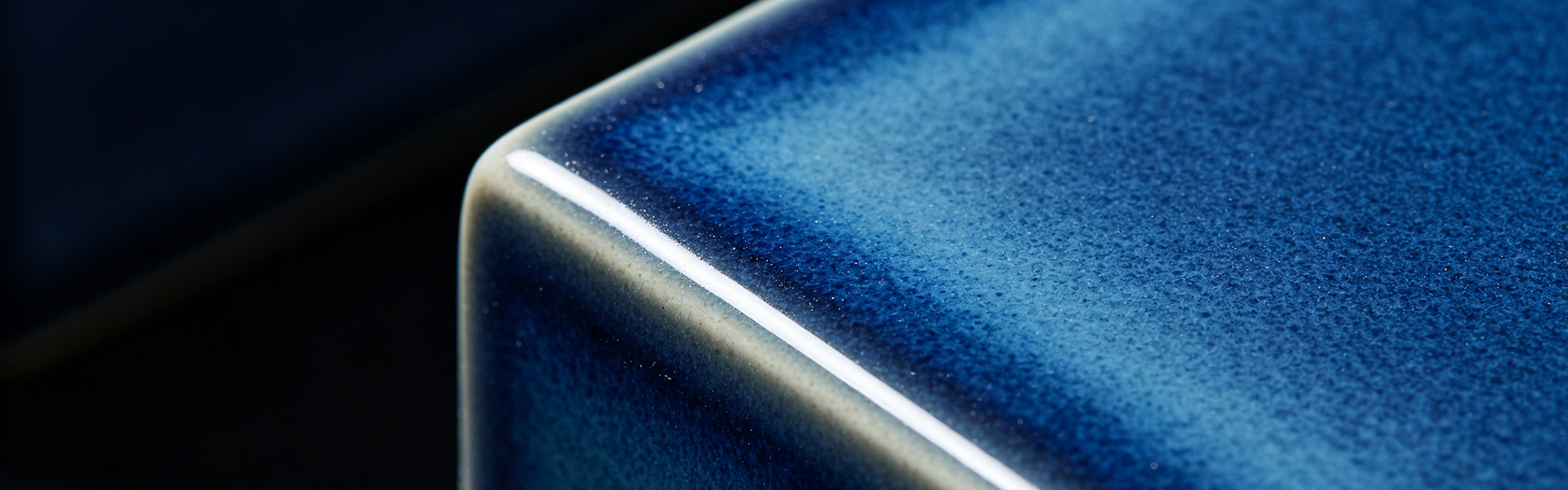
Zinc Oxide in Ceramic Glazes & Frits
ZnO is a versatile glaze ingredient: a strong flux that lowers melting temperature, an opacifier through formation of zinc-aluminum-silicate crystals during cooling, a matting agent at high loadings, and a color modifier that brightens copper and iron oxide pigments. Used in tile, sanitaryware, dinnerware, and art pottery glazes typically at 5–15 wt%.
Why Zinc Oxide for This Application
Function-by-function breakdown of how ZnO contributes to the final formulation.
- Flux & Melt Temperature Reduction — ZnO is a powerful low-temperature flux in ceramic glazes. Substituting 5–10% ZnO for traditional fluxes (CaO, MgO, K₂O) can lower the maturing temperature by 50–100 °C, enabling fast-fire production schedules and energy savings.
- Opacification Through Crystallization — On controlled cooling, ZnO combines with alumina and silica in the glaze melt to crystallize as zinc-aluminum-spinel (gahnite, ZnAl₂O₄) and willemite (Zn₂SiO₄). These crystals scatter light and produce smooth, opaque white finishes without the cost of TiO₂ or SnO₂.
- Matting / Satin Surface Effect — At higher loadings (8–15 wt%) with slow cooling, ZnO promotes microcrystalline phase growth that yields satin or matte surface effects — increasingly popular in modern tile aesthetics over pure gloss.
- Color Modification — ZnO brightens cobalt blue, brings out cleaner copper green, and shifts iron oxide colors toward yellow-brown rather than red-brown. Predictable color tuning lever for ceramic decorators.
Recommended Grade & Dosage
Pair the right purity tier and surface treatment with the production process.
Electronic Grade or Industrial Grade
Most ceramic glaze applications use industrial-purity ZnO (≥99.5%) for cost reasons. Electronic grade (≥99.95%) is specified for high-temperature dinnerware, lead-free art glazes, and applications where iron contamination would compromise color clarity (white/pastel glazes).
| Parameter | Value |
|---|---|
| Standard Glaze Flux | 5 – 10 wt% |
| Opaque White Glaze | 8 – 12 wt% |
| Matte / Satin Surface Glaze | 10 – 15 wt% |
| Ceramic Body Component | 1 – 5 wt% (electrical porcelain) |
Formulation & Process Notes
Working parameters and process control points from production experience.
| Parameter | Value |
|---|---|
| Firing Temperature Window | Cone 06 to Cone 10 (1000–1300 °C) — broad compatibility |
| Co-Fluxes | Feldspar (K-spar / Na-spar), CaO from whiting, MgO from talc |
| Network Formers | Silica (SiO₂) and alumina (Al₂O₃) from clay and feldspar |
| Cooling Schedule for Opacity | Slow cool through 900–700 °C (50–80 °C/h) to allow zinc-alumino-silicate crystallization |
| Compatible Colorants | Cobalt oxide (blue), copper oxide (green), iron oxide (yellow-brown), chromium oxide (green) |
| Incompatibilities | ZnO suppresses chrome-tin pink colors and degrades cadmium-selenium red pigments — avoid these combinations |
Frequently Asked Questions
+How does ZnO compare to barium carbonate as a glaze flux?
ZnO is a stronger low-temperature flux at lower dosage (5–10% vs barium at 8–15%) and is non-toxic, while barium carbonate is regulated as hazardous in many jurisdictions. ZnO produces brighter, cleaner whites and supports modern matte aesthetics better. Most contemporary glaze recipes have transitioned from barium to ZnO except for specific historical glaze effects (Bristol glazes).
+Why does ZnO sometimes cause glaze ‘crawling’ or pinholes?
Crawling occurs when ZnO content is too high (typically >15%) and the glaze melt has poor adhesion to the body. Pinholes can result from gas evolution if ZnO is poorly calcined or reacts with binders during firing. Both are formulation issues solved by: lowering ZnO dosage, using calcined ZnO, or adding 1–2% additional silica to improve melt fit.
+What firing range works with ZnO glazes?
Cone 06 (1000 °C) through Cone 10 (1300 °C) — ZnO is functional across nearly the entire ceramic firing range. Lower-temperature glazes use ZnO at the higher end (10–15%) for stronger flux action; high-fire glazes use 3–8%.
+Can ZnO be substituted by zinc carbonate or franklinite?
Zinc carbonate (smithsonite) decomposes to ZnO during firing and is sometimes used historically, but yields gas (CO₂) that can cause defects. Franklinite (ZnFe₂O₄) introduces iron and is unsuitable for white or pastel glazes. Pure ZnO is the modern standard.