
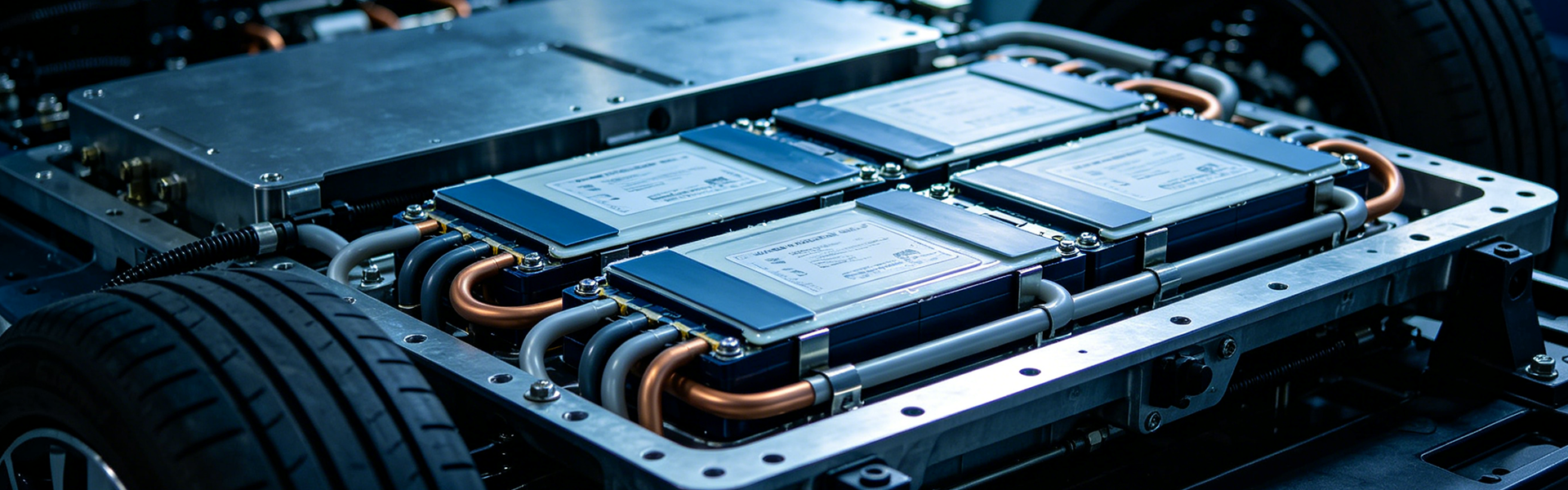
EV battery packs dissipate 5–20 kW of heat in stress conditions. The thin layer between cell and cooling plate is the bottleneck. SEMITECH supplies the silicone base polymer and crosslinker that battery TIM formulators build their gap-fillers, thermal pads, and dispense compounds
The battery thermal management challenge
A modern 100 kWh pack contains 100–8,000 cells. During fast charge or aggressive discharge, each cell generates 10–80 W of heat. Get the heat out unevenly and you get capacity divergence, accelerated aging, and at the extreme — thermal runaway. The TIM layer is where the heat path either succeeds or chokes.
Three TIM formats cover the modern pack: gap fillers (1- or 2-component, dispensed at module assembly), thermal pads (pre-formed sheets), and thermal grease (high-conductivity, low-modulus). Silicone chemistry dominates because of its temperature stability, low compression set, and ability to take heavy filler loading (up to 90 wt% alumina) without losing flexibility.
Addition-cure silicone chemistry
Battery TIMs are almost universally two-component addition-cure systems. Part A contains vinyl-terminated PDMS plus thermally conductive filler (alumina, AlN, BN). Part B contains hydrogen-functional silicone (Si–H) plus filler. When mixed, a platinum catalyst drives the Si–H + Si–CH=CH₂ hydrosilylation reaction, forming a crosslinked silicone elastomer. No byproducts, no shrinkage, and cure profile tunable from 5 minutes (heat) to 24 hours (room temperature).
Why addition cure beats condensation cure for batteries: Addition cure produces no water or alcohol byproducts that could outgas inside a sealed pack. Cure happens at ambient or modest heat without humidity dependence. Compression set is < 5% over 1000 hours at 125 °C — critical for cells that move thermally over 10+ year service life.
SEMITECH building blocks
Vinyl Silicone Fluid (Part A base)
Vinyl-terminated PDMS at viscosities from 100 to 100,000 cSt. Vinyl content 0.05–0.5 mol%. Forms the elastomer backbone after cure. Multiple chain lengths balance final hardness and tensile strength.
Hydrogen Silicone Fluid (Part B crosslinker)
Si–H functional pendant or chain-end silicone. H content 0.5–1.6 wt %. Multiple architectures (random, comb, telechelic) allow formulators to dial in crosslink density and final modulus.
MESIL OH Polymer (alternative)
For one-component RTV-style TIMs that condensation-cure on moisture exposure. Lower performance than addition cure but simpler dispense. Used in less-critical TIM and sealing applications.
Fumed Silica (rheology & reinforcement)
Optional add-back at 1–3 wt % for sag control and tear strength. Hydrophobic-treated grade prevents reaction with platinum catalyst.
Viscosity and dispense selection
| TIM Format | Mixed Viscosity | Vinyl Fluid Grade | Notes |
|---|---|---|---|
| Auto-dispense gap filler | 50,000–150,000 cP | MESIL VTM-5000 | Mass production, robotic dispense |
| High-rise gap filler | 200,000–500,000 cP | MESIL VTM-50000 | Vertical surfaces, anti-sag |
| Thermal pad (calendered) | 30,000–100,000 cP | MESIL VTM-1000 | Pre-formed sheet, post-cured |
| Thermal grease (non-cure) | 10,000–50,000 cP | MESIL VTM-100 | One-component, non-curing |
Selection guide
Filler is critical: Vinyl + hydrogen silicone alone gives ~0.2 W/m·K thermal conductivity. Loading with 70–85 wt% spherical alumina, AlN, or BN raises conductivity to 2–6 W/m·K. SEMITECH supplies the silicone base; we recommend separate qualified suppliers for thermal filler.
FAQ
+Why not use a thermosetting epoxy TIM instead?
Epoxy gives high modulus but cracks under cell expansion (5–10% over SOC swing). Silicone’s elastomer behavior absorbs cell breathing without mechanical fatigue. For modules that thermal-cycle thousands of times, silicone is the only viable choice.
+Do platinum catalysts get poisoned in production?
Yes — by sulfur, amines, and tin compounds. Battery production lines must keep solder flux residue, plasticizer-bearing rubber, and sulfur-cured EPDM out of contact with uncured TIM. SEMITECH datasheets include a poison-list reference.
+Can SEMITECH supply pre-mixed Part A / Part B compounds?
No — SEMITECH supplies the silicone fluid building blocks only. Final two-component formulation (with thermal filler, color paste, sag control) is performed by the TIM compounder. We support formulators with technical service and trial samples.
+What pot life can I expect?
Pot life depends on platinum loading and temperature. Standard formulations target 30–60 minutes at 25 °C with 5-minute cure at 100 °C. Inhibited grades extend pot life to 4–8 hours for slow dispense lines. Specify your cure profile — we’ll recommend the appropriate grade.
+Are SEMITECH silicones halogen- and hydrolyzable-Cl free?
Yes. Standard grades meet RoHS and REACH halogen limits. Hydrolyzable chloride is < 5 ppm — important for battery applications where chloride attacks aluminum bus bars.
Part of the Lithium Battery Materials hub. Formulation support and trial samples available on request.