
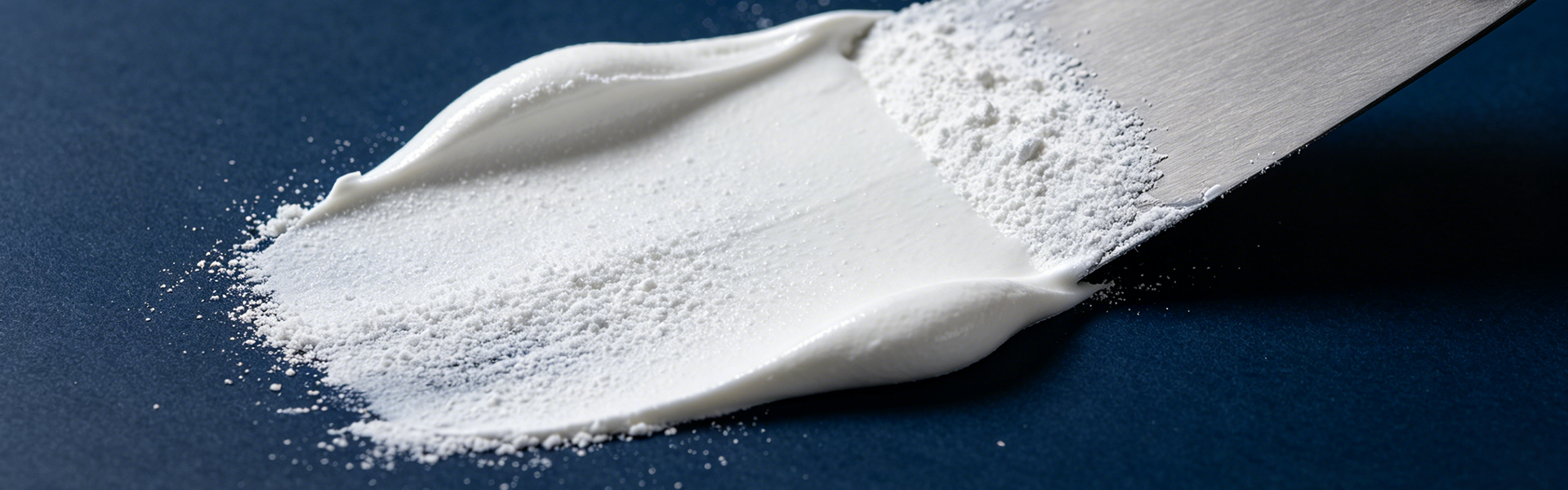
SEMISIL fumed silica builds the 3D hydrogen-bonded network that coating, ink, and adhesive formulators rely on for anti-settling and thixotropic performance — replacing organobentonite, castor wax, and polyamide-wax thixotropes in solvent-based and waterborne systems.
Anti-Settling vs Thixotropic — Two Behaviors, One Mechanism
A particulate network holds the liquid phase rigid at rest and yields under shear — delivering both anti-settling and thixotropy from a single grade of fumed silica.
| Behavior | State | What the formulator measures | End-user benefit |
|---|---|---|---|
| Anti-settling | Static (storage, transport) | Brookfield viscosity at 0.5 rpm; 30-day pigment-layer test | No hard-sediment after 6+ months; consistent shade at point of use |
| Thixotropic | Dynamic (spray, brush, mixing) | Thixotropic index (ηlow/ηhigh); recovery time post-shear | No sag on vertical surfaces; clean spray atomization; brush leveling |
Where the Network Matters
Industrial & Protective Coatings
Sag-resistant epoxy and polyurethane topcoats on vertical steel structures. Typical loading 1.0–2.0%.
Architectural & Decorative Paint
Pigment anti-settling in TiO₂-loaded waterborne emulsion paints; controlled drip in roller and brush application.
Automotive Refinish
Thixotropic flow control in 2K spray basecoats, metallic flake orientation, sag prevention on body panels.
Printing Inks
Pigment dispersion stability and short-set rheology for high-speed web presses.
RTV Silicone Sealants
Extrusion-quality flow under cartridge pressure, slump-free tooling after application.
Adhesives & Mastics
Controlled bead profile, no flow on vertical substrates in epoxy, PU, and MS-polymer adhesives.
Unsaturated Polyester & Vinyl Ester
Fiber wet-out without resin drain on vertical mould surfaces; pigment anti-settling in pre-coloured gel coat.
Why Fumed Silica Outperforms Organic Thixotropes
| Property | Fumed silica (SEMISIL) | HCO castor wax | Organobentonite | Polyamide wax |
|---|---|---|---|---|
| Activation | Cold dispersion + high-shear mill | Hot dissolution 50–65 °C | Pre-gel with polar activator | Hot grind > 80 °C |
| Film transparency | Transparent at 0.5–2.0% | Slight haze | Visible tint/haze | Slight cloudiness |
| Polar/nonpolar versatility | Both (grade selection) | Polar systems only | Nonpolar preferred | Both |
| Re-dispersion after settling | Yes — gentle stir | Hard cake risk | Hard cake risk | Hard cake risk |
| Regulatory status | EINECS listed, food contact grades available | Allergen concerns (castor bean) | Contains quaternary ammonium | Clean label variants only |
Recommended SEMISIL Fumed Silica Grades
| Grade | BET (m²/g) | Surface | Best for |
|---|---|---|---|
| SEMISIL 200 | 200 ± 25 | Hydrophilic | Waterborne architectural and industrial coatings |
| SEMISIL 300 | 300 ± 30 | Hydrophilic | High-pigment-volume waterborne emulsions, inks |
| SEMISIL R-202 | 200 ± 25 | PDMS-treated hydrophobic | Solvent-based coatings, clear lacquers |
| SEMISIL R-972 | 110 ± 20 | DDS-treated hydrophobic | 2K polyurethane and epoxy coatings |
| SEMISIL R-805 | 150 ± 25 | Octylsilane hydrophobic | RTV sealants, solvent-based adhesives |
All grades are available in 10 kg multi-wall paper bags and 250 kg bulk bags. MOQ 1 MT per grade.
Dosage & Processing — Practical Formulation Guidance
Typical loading
- Architectural emulsion paint: 0.3–0.8% on total formulation weight
- Industrial solvent-based coatings: 0.8–1.5%
- RTV sealants and adhesives: 5–12% (acts as both reinforcing filler and thixotrope)
- Unsaturated polyester gel coat: 1.5–2.5%
- Printing inks: 0.5–1.5%
Dispersion requirements
- Peripheral disc speed 10–15 m/s minimum to break primary aggregates
- Add silica to the resin / vehicle before pigment grind
- For waterborne systems, pre-wet hydrophobic grades in a co-solvent (glycol ether) before water-phase addition
Order of addition
- Charge resin and solvent to mixer
- Add SEMISIL fumed silica slowly under increasing shear
- Disperse 15–20 min at 10–15 m/s peripheral speed
- Add pigment, extenders, additives
- Let down to final viscosity
FAQ — Anti-Settling & Thixotropic Formulation
Q1: How does fumed silica prevent pigment hard-settling during 6+ months of storage?
A 0.5–1.5% loading creates a continuous 3D hydrogen-bonded network whose yield stress (1–10 Pa) exceeds the gravitational stress on suspended pigments. Even if a soft sediment forms, gentle stirring re-incorporates it — no hard-cake compaction.
Q2: What is the difference between hydrophilic and hydrophobic fumed silica for anti-settling?
Hydrophilic grades (SEMISIL 200/300) work best in polar systems — waterborne paints, alcohol-based inks. Hydrophobic grades (R-202/R-972/R-805) are treated to repel water, ideal for solvent-based systems.
Q3: Why is fumed silica preferred over organobentonite for clear topcoats?
Fumed silica is optically transparent at typical loadings because its primary aggregates are below 200 nm. Organobentonite particles are larger and carry surface pigmentation that produces visible tint and haze.
Q4: Can fumed silica replace polyamide wax thixotropes one-to-one?
Not 1:1 by weight, but SEMISIL 200 achieves equivalent thixotropic index at 0.5–1.5% versus 0.8–2.0% polyamide wax — and disperses cold without hot-grinding.
Q5: What grade works best for waterborne architectural paint?
SEMISIL 200 at 0.3–0.8% loading controls TiO₂ anti-settling and brush-drag rheology without affecting open time. For PVC > 60% formulations, SEMISIL 300 provides stronger network structure.
Q6: How much shear is needed to fully disperse fumed silica?
A high-speed disperser with 10–15 m/s peripheral disc speed for 15–20 minutes is the minimum. Below 8 m/s, thickening efficiency drops sharply. Above 20 m/s and beyond 30 minutes, over-shearing damages the aggregate skeleton.