
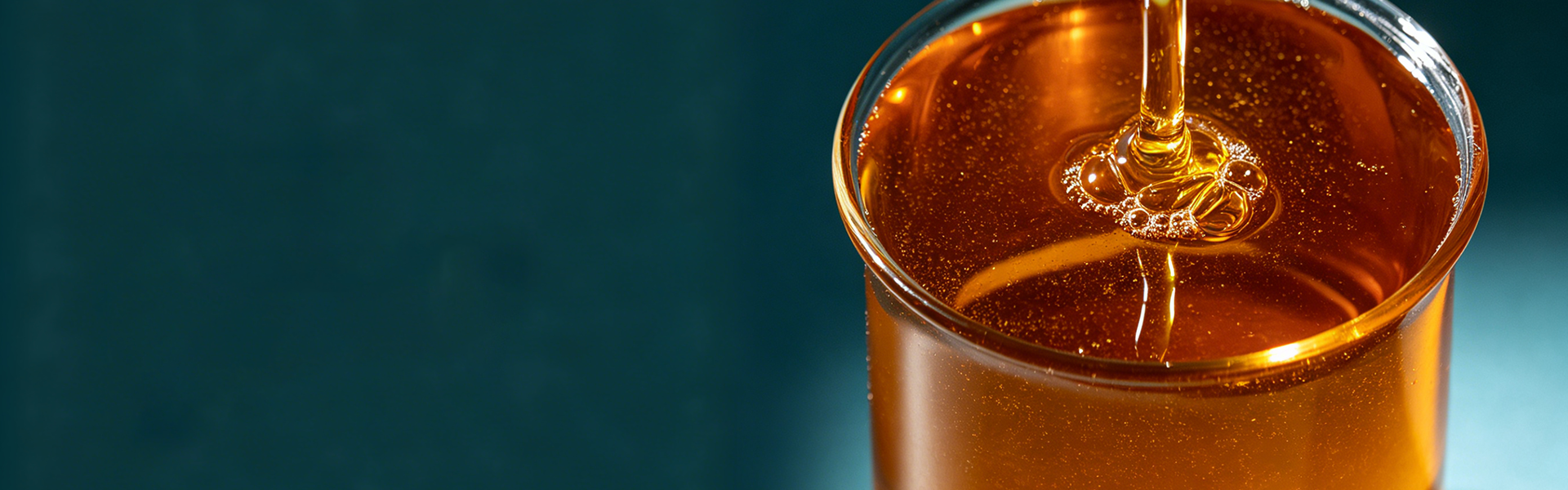
SEMITECH KR-46B — Treated Isopropyl Tri(dioctyl phosphato) Titanate
KR-46B depends on isopropyl titanate (IPT) and dioctyl phosphate. IPT spot prices in Q1 2026 ranged $4.20–$5.10/kg CFR China, up 22% YoY on TiCl₄ constraints. Combined upstream pressures add $0.35–0.55/kg versus 2024 baseline.
Technical Specifications
| Raw Material | Key Producers | Supply Status (Q1 2026) | Price Trend |
|---|---|---|---|
| Isopropyl titanate (IPT) | Teijin (JP), Dorf Ketal (IN), Shaanxi Sino (CN) | Tight; rutile/TiCl₄ constraints | ↑ +22% YoY |
| Dioctyl phosphoric acid | BASF, LG Chem, Aekyung (KR) | Moderate tightness | ↑ +8% YoY |
| 2-Ethylhexanol (upstream) | Sasol, INEOS, Shandong Yuhuang (CN) | Recovering; new CN capacity Q2 2026 | → Stable |
| Isopropanol (IPA) | Regional commodity | Ample supply | ↓ Slight softening |
Surface Chemistry
KR-46B is isopropyl tri(dioctyl phosphato) titanate. Phosphate groups chemisorb onto hydroxyl-rich surfaces (TiO₂, CaCO₃, BaSO₄, kaolin) via proton exchange, forming Ti–O–P bonds. The mono-phosphate structure gives denser surface monolayer coverage on high-BET substrates (>10 m²/g) than pyrophosphato variants — the preferred B-grade for pigment-heavy formulations.
▶Show full content (3 sections)
Dosing Efficiency Versus KR-12
KR-46B reaches equivalent dispersion quality at 0.5–0.8 wt% versus 0.7–1.1 wt% for KR-12 under identical conditions. In a 40% PVC TiO₂ alkyd system, KR-46B reduces grind time 12–18% and post-let-down viscosity 8–15 KU. A structurally justified cost-rational substitution for KR-12 on medium-BET pigments.
Application Parameters
Pale-yellow liquid, viscosity 15–30 cP at 25°C, flash point ~93°C. Thermal stability to 200°C covers all stoving enamel cure cycles. Best results on pigments with BET 5–50 m²/g. For ultra-fine TiO₂ (BET >80 m²/g), increase loading 15%. Add to mill-base before pigment charge; pre-dilute 1:1 in mineral spirits.
Frequently Asked Questions
+Q: When should I choose KR-46B over KR-12?
A: KR-46B achieves full monolayer coverage at 15–25% lower mass loading on medium-BET pigments (5–50 m²/g). Choose KR-12 for very high-surface pigments above 80 m²/g.
+Q: Can KR-46B be used in waterborne systems?
A: Primarily for solvent-borne. It can be incorporated into waterborne if pre-diluted 1:1 in a water-miscible co-solvent, but hydrolytic stability is limited. For dedicated waterborne, evaluate KR-9S.
+Q: Which pigments respond best?
A: Hydroxyl-rich surfaces: rutile TiO₂ (BET 5–25 m²/g), precipitated CaCO₃, BaSO₄, and calcined kaolin. Less effective on carbon black and organic pigments.
+Q: Is KR-46B compatible with amine-cured epoxy?
A: Yes — add to the resin component, not the hardener. With >20 phr polyamine hardener, verify surface treatment retention by contact angle measurement.
+Q: What is the current pricing?
A: Q1 2026: $12–17/kg depending on volume. Upstream IPT tightness (+22% YoY) is the primary cost driver. Lead times 4–5 weeks from Chinese producers.
+Ready to optimise your formulation?
Contact the Semitech technical team for product recommendations, samples and TDS.