
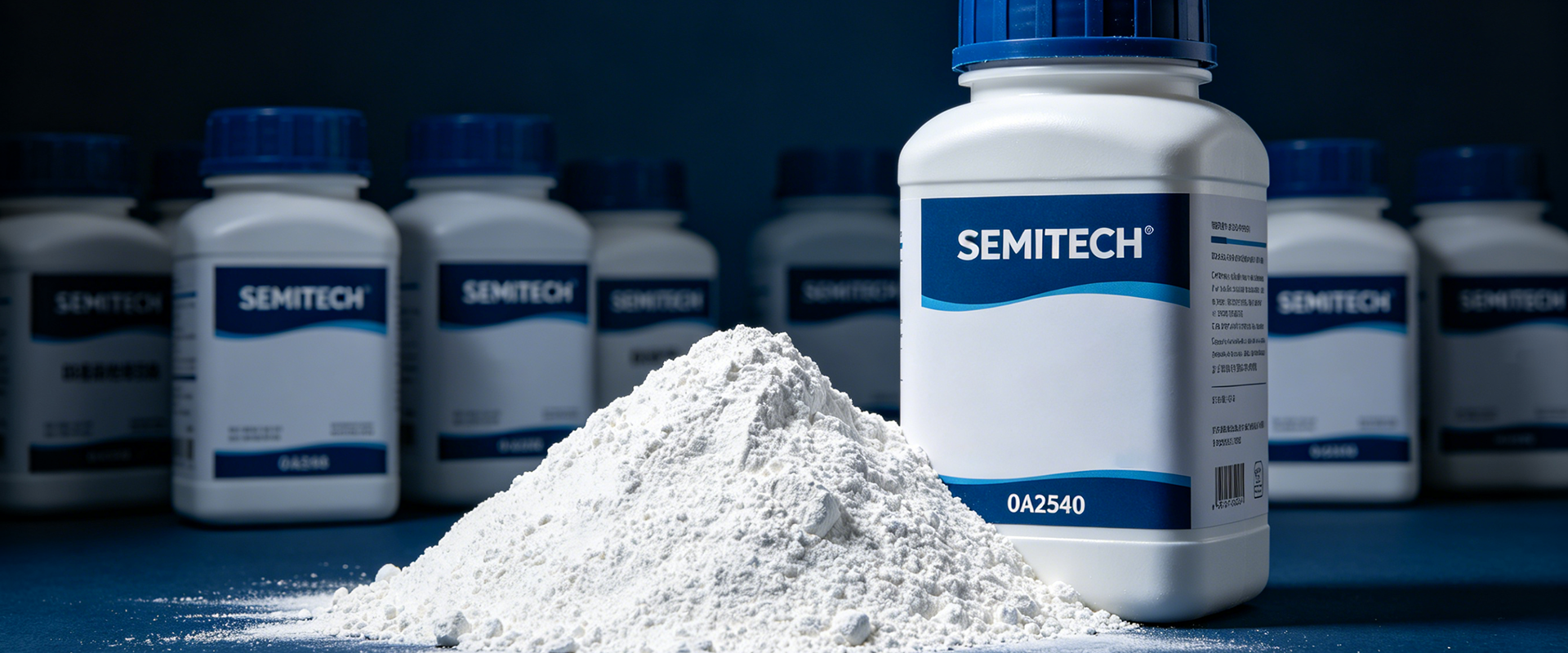
Zinc Oxide: SEMITECH Portfolio — Rubber, Coating, Glass-Ceramic, Pharma, Cosmetic, Food, Feed and Functional Grades from a 72,000 MT/year Manufacturer
SEMITECH supplies premium zinc oxide (ZnO, CAS 1314-13-2) across 8 industrial grades — rubber & tyre, paint & coating, glass & ceramic, pharma & cosmetic (USP / EP / Ph.Eur), food, feed additive, granule, and functional / nano — sourced from a 30-year Chinese manufacturer with 72,000 MT/year capacity and 30+ patents.
Contents
| 8 | 72,000 t | 25 kg |
|---|---|---|
| ZnO grades stocked | Annual capacity | Standard MOQ |
Why Zinc Oxide: A Cross-Industry Inorganic Workhorse
Zinc oxide (ZnO, CAS 1314-13-2) serves rubber vulcanization, UV-shielding coatings, ceramic glazes, pharma sunscreens, food fortification, and feed supplementation. Each market demands different purity — pharma requires ≤10 ppm heavy metals while rubber trades purity for cost. SEMITECH's eight grades are manufactured in dedicated production lines to prevent cross-contamination.
Our supply chain integrates with a 72,000 MT/year manufacturer operating since 1995 with 30+ patents and a six-step QC protocol covering raw material through to packaging.
Tier 1: Industrial Volume Grades — Rubber, Coating, Glass & Ceramic
Rubber & Tyre Grade ZnO
Industrial-grade ZnO at D50 0.5–2 µm / BET 4–10 m²/g — the activator for sulfur vulcanization in passenger tyres, TBR truck tyres, EPDM weatherstrip and rubber compounds. Loading 3–5 phr.
Rubber-grade ZnO is the highest-volume application globally. ZnO reacts with stearic acid and sulfur accelerators to form the active zinc complex catalysing crosslink formation. SEMITECH supplies indirect-process (French process) ZnO at 99.7%+ purity, low-Pb (≤10 ppm), consistent BET.
Paint & Coating Grade ZnO
Coating-grade ZnO at D50 0.3–3 µm — opacifying pigment + UV-shielding additive + zinc-rich-primer anti-corrosion booster. Surface treatment available for solvent-borne and waterborne dispersion.
Serves three coating roles: opacifying pigment (RI 2.0), UV shield (absorbs below 380 nm), and anti-corrosion booster. Loading: 1–3% in architectural paint, 5–15% in zinc-rich primer, 0.5–2% as UV-shield in clear-coat.
Glass & Ceramics Grade ZnO
Ceramic-grade ZnO at ≥99.5% purity with controlled trace iron (<50 ppm) — flux additive for ceramic glaze, glass frit, and soft-magnetic ferrite formulations.
Lowers melting point of silicate glasses by 50–100°C, raises gloss, and improves chemical durability. Loading: 5–15% in glass frit, 2–8% in ceramic glaze, 8–25% in soft-magnetic ferrite.
▶Show full content (6 sections)
Tier 2: High-Purity Grades — Pharma, Cosmetic, Food, Feed
Pharma & Cosmetic Grade ZnO (USP / EP / Ph.Eur)
USP / EP / Ph.Eur compliant ZnO at ≥99.9% purity, residual heavy metals ≤10 ppm — for sunscreen UV-blocker, dermatology cream, antimicrobial topicals, and cosmetic foundation.
Non-nano grades (≥100 nm) provide broad-spectrum UV protection; nano-grades (10–50 nm) deliver transparent finish. Also serves calamine ointment, diaper-rash creams, and cosmetic powder applications. Food-grade lined drums under N₂; full pharmacopoeia CoA panel.
Food Grade ZnO
FCC / JECFA-compliant ZnO at ≥99.5% purity, low-Pb (≤2 ppm), pathogen-free — for cereal / infant formula / vitamin tablet zinc fortification under GMP-compliant production line.
Dedicated GMP line with full traceability and HACCP documentation. Typical fortification: 1–10 mg Zn/100 g for cereals, 10–50 mg Zn/serving in supplements.
Feed Additive Grade ZnO
Veterinary feed-grade ZnO at ≥99% purity, FAMI-QS certified — zinc supplementation for poultry, swine, ruminants and aquaculture at 50–200 ppm of compound feed.
Complies with EU 1831/2003. SEMITECH supports both lower-dose nutritional ZnO and zinc chelate transition pathways following EU post-2022 high-dose restrictions.
Tier 3: Specialty Grades — Granule, Functional / Nano, Zinc Citrate
Granule ZnO (Pelletised)
Pre-densified 0.5–3 mm pellets eliminating dust handling for tyre, rubber, and powder-coating compounders. Same purity and reactivity as powder grade after compounding dispersion.
Premium 8–15% over powder grade — payback is rapid where dust-handling overhead dominates production cost.
Functional / Nano ZnO
Nano ZnO at D50 10–50 nm / BET 30–80 m²/g — transparent UV-blocker, photocatalysis, antibacterial functional textile, and DSSC photoanode applications.
Surface-treated grades (silane, silica-coated, polymer-encapsulated) prevent agglomeration in waterborne and solvent-borne carriers.
Zinc Citrate (Companion Product)
Companion organic-zinc product (Zn₃(C₆H₅O₇)₂·3H₂O, CAS 5990-32-9) at ≥97% purity — high-bioavailability zinc for pharmaceutical supplementation, oral-care, and food fortification.
Manufacturing Capacity and Quality Control
72,000 MT/year capacity across multiple production lines. ISO 9001, ISO 14001, and FAMI-QS certified. Six-step QC: raw zinc metal traceability, reaction monitoring, milling + BET, blending homogeneity, sieving + PSD, and packaging integrity + final CoA.
Standard packaging: 25 kg paper bags (palletised 1 t) for industrial; 25 kg fibre drums with food-grade liner for pharma/food/feed; 1-tonne bulk-bags for high-volume. MOQ 25 kg sample, 1 t production. Lead time 2–3 weeks to Asia, 4–5 weeks to Europe/North America.
SEMITECH Zinc Oxide Grade Reference
All eight ZnO grades (plus zinc citrate companion product) are inventoried with CoA per shipment. Industry-standard equivalencies provided for buyer cross-qualification.
| Tier | Grade | Purity | D50 / BET | Compliance | Primary Application |
|---|---|---|---|---|---|
| 1 | Rubber & Tyre Grade | ≥99.7% | 0.5–2 µm / 4–10 m²/g | REACH / RoHS | Tyre, EPDM, conveyor belt vulcanization |
| 1 | Paint & Coating Grade | ≥99.5% | 0.3–3 µm | REACH / VOC | Architectural / industrial coatings, zinc-rich primer |
| 1 | Glass & Ceramics Grade | ≥99.5% | 1–5 µm | low-Fe (<50 ppm) | Glass frit, ceramic glaze, soft-magnetic ferrite |
| 2 | Pharma / Cosmetic Grade | ≥99.9% | 0.1–1 µm (non-nano) | USP / EP / Ph.Eur | Sunscreen, dermatology, cosmetic foundation |
| 2 | Food Grade | ≥99.5% | 1–3 µm | FCC / JECFA | Cereal / infant formula / vitamin tablet fortification |
| 2 | Feed Additive Grade | ≥99% | 1–5 µm | FAMI-QS / EU 1831/2003 | Poultry, swine, aquaculture feed supplement |
| 3 | Granule (Pelletised) | ≥99.7% | 0.5–3 mm pellet | REACH / RoHS | Dust-free dosing for tyre / rubber / powder coatings |
| 3 | Functional / Nano | ≥99.5% | 10–50 nm / 30–80 m²/g | REACH | Transparent UV-block, photocatalysis, antibacterial |
| 3 | Zinc Citrate Trihydrate | ≥97% | D50 5–15 µm | USP / FCC | Zinc supplementation, oral-care, dental |
FAQ
+Indirect-process (French) vs direct-process (American) ZnO — which does SEMITECH supply?
SEMITECH supplies indirect-process (French) ZnO for all grades. The indirect process oxidises pre-purified molten zinc metal, delivering tighter purity control and lower residual lead/cadmium than the direct process which oxidises zinc-bearing ore directly.
+How does pharma / cosmetic-grade ZnO comply with EU heavy-metal limits?
SEMITECH pharma-grade routinely tests at Pb ≤2 ppm, As ≤1 ppm, Cd ≤0.5 ppm, Hg ≤0.1 ppm — well below EU cosmetic regulation limits. Per-batch CoA with full ICP-MS panel. Nano-ZnO (≤100 nm) requires additional safety dossier under EU CMR Annex II.
+Why does my rubber compound show inconsistent cure rate from batch to batch?
Usually traces to ZnO parameter drift: (1) BET surface area outside 4–10 m²/g range; (2) residual chloride accelerating scorch (SEMITECH limits ≤50 ppm); (3) moisture absorption in opened drums. Specify N₂-blanketed packaging and consume within 30 days of opening.
+Is granule (pelletised) ZnO worth the 8–15% premium over powder?
For automated dosing operations, dust-related losses typically exceed 10–20% of ZnO consumption. Granule recovers most of that loss and improves OEE by 2–4 percentage points.
+What MOQ, packaging and lead times apply across grades?
Sample: 25 kg, 5–7 days. Production: 1 t minimum (industrial), 200 kg (high-purity), 100 kg (nano/zinc citrate). Bulk 25 t FCL available for rubber/coating grades. Lead time 2–3 weeks Asia, 4–5 weeks Europe/North America.
Related SEMITECH Product Hubs
Other portfolios from the SEMITECH catalog that complement this hub — adjacent product families and cross-application materials.