
Products›Silicone Materials›Defoamers Hub
Silicone Defoamers: SEMITECH Portfolio — Polyether-Modified, Mineral-Oil-Based, Waterborne, Food-Grade & Pulp/Paper Defoamer Systems
SEMITECH supplies 5 silicone-based defoamer grades engineered for the dominant industrial foam-control applications — coatings, paper pulping, food processing, fermentation, and wastewater treatment — manufactured at our own siloxane plant in Zhejiang with 25 kg MOQ and 1–3 week ex-China lead times.
Contents
| 5 | 0.01–0.5% | 25 kg |
|---|---|---|
| Defoamer grades in portfolio | Typical use level (formulation) | Standard MOQ |
How Silicone Defoamers Work: Spreading, Bridging, and Bubble Rupture
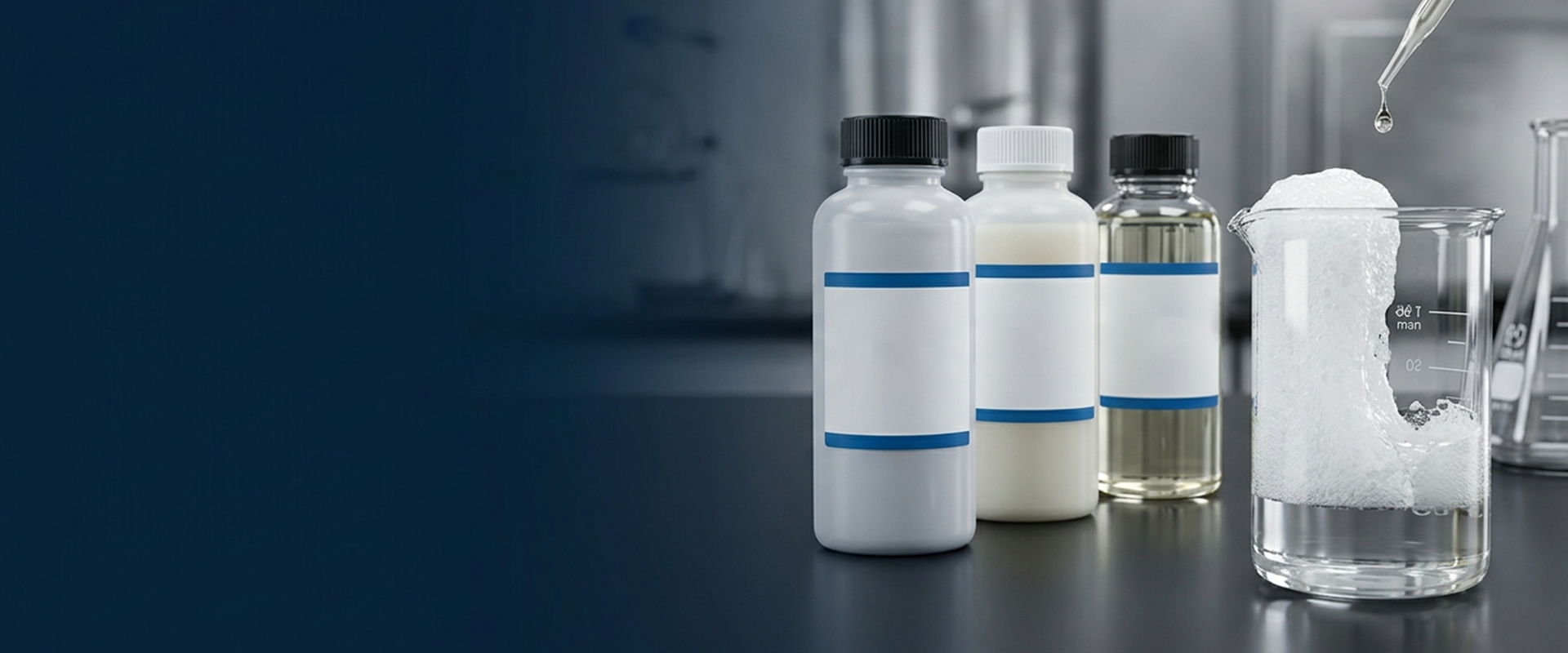
How silicone defoamers rupture foam — surface-tension gradient plus hydrophobic-silica bridging drains the foam lamella in milliseconds at 50–500 ppm dosage.
The defoamer droplet enters the foam lamella, spreads across the interface via its low surface tension (~20 mN/m), and produces a localised gradient that drains the lamella. Hydrophobic silica particles physically rupture the thinned film. A properly formulated defoamer at 50–500 ppm suppresses 80–95% of foam volume.
Polyether-modified silicones are the workhorse for waterborne coatings — polyether grafts provide water-dispersibility without surface defects. Mineral-oil-carrier systems are dosed into pulping and wastewater for bulk knockdown. USP-grade PDMS emulsions are specified for fermentation, food, and pharmaceutical applications.
Coatings and Inks: Polyether-Modified Silicone Workhorses
Polyether-modified PDMS for waterborne paints and inks — controlled silicone/polyether balance gives foam knockdown without crater or fish-eye surface defects.
- MeFoam-PE Low-MW — Fast-drying clear coatings; 0.05–0.2% loading; minimal surface tension impact
- MeFoam-PE High-MW — Architectural emulsion paints; 0.1–0.4% loading; sustained foam control
For solvent-borne systems, MeFoam-Si (modified PDMS in solvent carrier) at 0.1–0.5% substitutes for BYK-066N and TEGO Foamex-N equivalents.
▶Show full content (6 sections)
Pulp, Paper and Wastewater: Mineral-Oil-Carrier Systems
Mineral-oil-carrier defoamers for pulping liquor, paper-machine wet-end, and industrial wastewater — high-volume, low-cost knockdown at 100–500 ppm.
MeFoam-MO (silicone + hydrophobic silica + mineral oil + emulsifier) at 100–500 ppm provides bulk foam suppression. The mineral oil carrier biodegrades over 14–28 days under normal sludge retention conditions.
Food and Fermentation: USP / FDA-Compliant Grades
USP-grade fully-cured PDMS emulsions for fermentation broth, food processing, and pharmaceutical-grade foam control with FDA / EU 21 CFR 175.300 compliance.
MeFoam-FG is a 30% PDMS emulsion compliant with FDA 21 CFR §173.340 and USP class VI. Use level 50–500 ppm on broth volume. Survives standard sterilisation cycles (121°C / 15 min).
Procurement, Compatibility Testing and Use-Level Optimisation
MOQ 25 kg, 1–3 week ex-China lead time, CoA on every shipment with active silicone content and silica loading.
Three rules: (1) start at 50% of recommended dose and titrate up; (2) screen every batch on actual production substrate; (3) verify storage stability at warehouse temperature. SEMITECH provides 100-mL screening samples at no charge. Lead time 1–2 weeks Asia, 3–5 weeks Europe/North America. Shelf life 12 months for emulsions, 24 months for solvent-carrier systems.
SEMITECH Defoamer Grade Reference: Key Specifications
Five stocked grades with carrier system, active silicone content, dosage range, and primary application.
| Grade | Chemistry / Carrier | Active Content | Typical Loading | Primary Application | Compliance |
|---|---|---|---|---|---|
| MeFoam-PE Low-MW | Polyether-modified PDMS / 100% active | 100% | 0.05–0.2% | Waterborne clear coatings, gravure inks | REACH |
| MeFoam-PE High-MW | Polyether-modified PDMS / 100% active | 100% | 0.1–0.4% | Architectural emulsion paint | REACH |
| MeFoam-Si | Modified PDMS in aromatic solvent | 10–15% silicone | 0.1–0.5% | Solvent-borne industrial coatings | REACH |
| MeFoam-MO | Silicone-on-mineral-oil with hydrophobic silica | 8–15% silicone | 100–500 ppm | Pulp & paper, wastewater treatment | REACH; biodegradable |
| MeFoam-FG | PDMS emulsion (30% solids) | 30% silicone | 50–500 ppm | Fermentation, food processing, dairy CIP | FDA 21 CFR §173.340; USP class VI |
FAQ
+Polyether-modified or solvent-carrier silicone for waterborne wood coatings?
Polyether-modified (MeFoam-PE Low-MW) is the standard choice. Start at 0.1%; increase by 0.05% increments if foam persists during pump recirculation.
+My waterborne paint shows fish-eye craters after switching defoamer. What happened?
Over-dosing or too-high silicone content. Reduce dose by 50% and re-test; if foam control then inadequate, switch to higher-MW polyether-modified grade rather than increasing dose.
+Is MeFoam-FG suitable for direct addition to fermentation broths?
Yes. Compliant with FDA 21 CFR §173.340. Dose 50–500 ppm; titrate to lowest effective level since residual silicone may interfere with downstream purification.
+How does SEMITECH compare with BYK-024, TEGO Foamex-810, and Wacker Pulpsil?
Same chemistry classes. Performance gap <5% on standardised tests at equivalent active content. Cost 30–45% lower landed-to-Asia. Most formulators complete dual-source qualification within 2–3 trial batches.
+What is the shelf life for silicone defoamer emulsions?
Emulsions (MeFoam-FG): 12 months at 5–35°C; do not freeze. Concentrates (MeFoam-PE, MeFoam-Si): 24 months. Mineral-oil-carrier (MeFoam-MO): 18 months above freezing.
+What is the MOQ and sample availability?
MOQ 25 kg per grade. 100-mL screening samples at no charge for qualification. Samples ship within 5 working days.
Related SEMITECH Product Hubs
Other portfolios from the SEMITECH catalog that complement this hub — adjacent product families and cross-application materials.