
Titanium Alkoxides Supplier — TPT, TBT, TET, TEHT & Poly-Butyl Titanate Portfolio
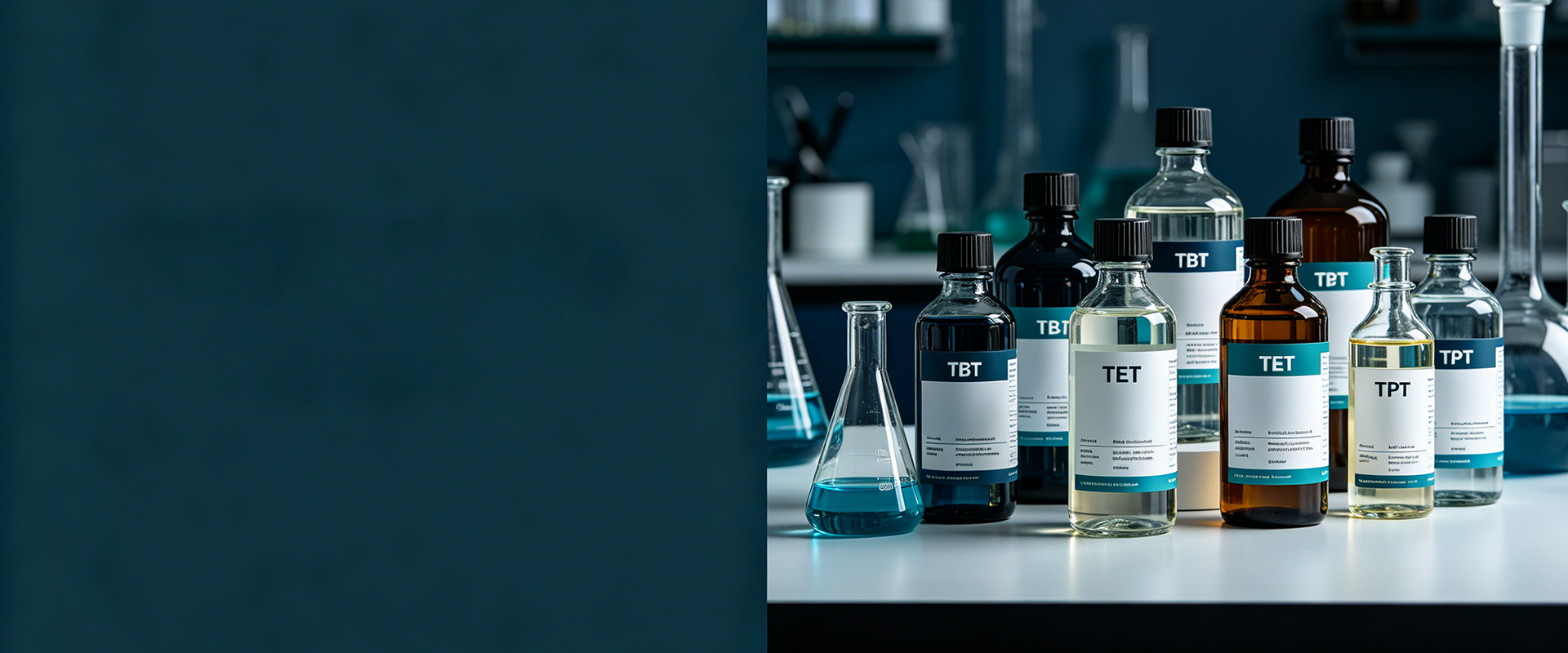
SEMITECH stocks five titanium alkoxide grades — TPT, TBT, TET, TEHT, and poly-butyl titanate — for PET polymerization, sol-gel deposition, and industrial esterification.
Contents
| ≥99% | 5 | 5–15 ppm |
|---|---|---|
| Ti compound purity | Commercial grades stocked | Ti dosing rate in PET |
Five-Grade Portfolio: Alkoxide Selection by Application
SEMITECH's range spans five grades differentiated by alkyl chain length and hydrolysis rate. All grades are supplied at ≥99.0 wt% Ti compound purity with full CoA and ICP-OES verification.
- TPT — Tetraisopropyl titanate — fast hydrolysis, sol-gel precursor, crosslinker for coatings and adhesives.
- TBT — Tetra-n-butyl titanate — PET polycondensation catalyst benchmark; broad industrial use.
- TET — Tetraethyl titanate — highest Ti wt% (21%), preferred for optical-grade TiO2 sol-gel films.
- TEHT — Titanium 2-ethylhexyl titanate — bulky ligands extend pot life >8 h; moisture-tolerant systems.
- BPT — Poly-butyl titanate — oligomeric TBT; reduced volatility and leaching in esterification duty.
PET Catalyst: Upstream Feedstocks and Downstream Demand
TBT is the dominant titanium-based PET polycondensation catalyst, replacing antimony trioxide where EU and FDA metal-migration limits apply. Catalyst dosing of 5–15 ppm Ti means small alkoxide supply swings carry disproportionate PET output leverage. TiCl4 allocation to pigment-grade TiO2 production periodically constrains alkoxide availability during Q3 coatings demand peaks.
▶Show full content (5 sections)
Sol-Gel Precursor & Esterification: Industrial Use Cases
TPT and TET serve as sol-gel precursors for TiO2 thin films in photocatalytic coatings, optical interference layers, and DSSC photoelectrodes. TEHT's bulky 2-ethylhexyl ligands slow hydrolysis, extending pot life to >8 hours versus <30 minutes for TPT. BPT acts as a Lewis acid catalyst at 160–220 °C for fatty acid esterification, achieving conversion >97%.
Supply Chain Dynamics, Trade Flows & Pricing Outlook
Chinese producers hold ~65% of global titanium alkoxide capacity, concentrated in Jiangsu and Shandong. TBT export pricing ranged USD 3,800–5,200/tonne in 2024–2025. SEMITECH holds bonded-warehouse inventory with 2–4 week lead times to APAC ports.
Grade Specification Comparison
| Grade | Chemical Name | CAS | MW (g/mol) | Ti wt% | Viscosity (mPa·s, 25°C) | Shelf Life | Primary Use |
|---|---|---|---|---|---|---|---|
| TPT | Tetraisopropyl titanate | 546-68-9 | 284.2 | 16.86 | 2–4 | 24 months | Sol-gel, crosslinker |
| TBT | Tetra-n-butyl titanate | 5593-70-4 | 340.3 | 14.07 | 8–20 | 24 months | PET catalyst, coatings |
| TET | Tetraethyl titanate | 3087-36-3 | 228.1 | 21.00 | 1–3 | 24 months | Sol-gel, optical film |
| TEHT | Titanium 2-ethylhexyl titanate | 1070-10-6 | 564.8 | 8.49 | 50–200 | 24 months | Moisture-resistant coatings |
| BPT | Poly-butyl titanate | 9022-96-2 | ~1,000–3,000 | ~12–14 | 500–5,000 | 18 months | Esterification, adhesion |
For PET catalyst qualification, TBT remains the industry benchmark at 5–15 ppm Ti dosing; evaluate TEHT or BPT for moisture-exposed environments.
FAQ
+What is the difference between TBT and poly-butyl titanate (BPT)?
BPT is an oligomeric form of TBT (DP 4–10), giving higher viscosity and lower vapor pressure. Its structure reduces catalyst leaching, making it preferred for esterification and moisture-tolerant systems.
+Why is TBT preferred over antimony trioxide as a PET catalyst?
TBT meets EU Regulation 10/2011 and FDA 21 CFR limits on metal migration and produces lower acetaldehyde generation — critical for food-contact PET bottle resins.
+How should titanium alkoxides be stored to prevent hydrolysis?
Store under dry nitrogen in sealed containers at 15–25 °C. TPT and TET tolerate only brief air exposure. Shelf life is 24 months under inert conditions.
+What BET surface area can be expected from TPT-derived sol-gel TiO2?
Calcination at 400 °C yields BET 40–80 m²/g depending on water-to-alkoxide ratio (R = 4–10). Above 600 °C, anatase-to-rutile transition collapses surface area below 20 m²/g.
+How does upstream TiCl4 supply affect titanium alkoxide pricing?
TiCl4 is shared with pigment-grade TiO2. During peak demand, producers allocate TiCl4 to pigment lines, pushing alkoxide spot prices 15–30% higher. Hedge with 3–6 month forward contracts.
+Which titanium alkoxide grade is best suited for fatty acid esterification?
Poly-butyl titanate (BPT) at 0.05–0.2 wt% catalyst loading delivers >97% conversion for C12–C18 substrates with minimal catalyst leaching.