
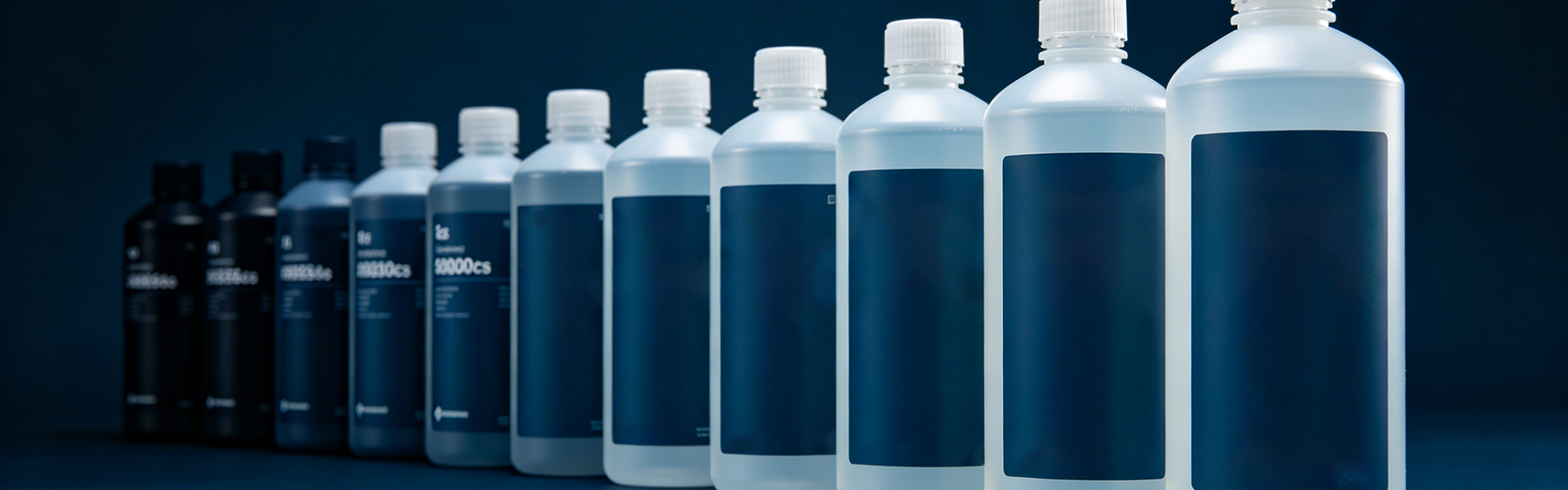
Silicone Fluid Viscosity Grade Guide — 5cs to 600,000cs Explained
Low-Viscosity Grades (5–200 cSt): Penetration, Wetting, and Spray
PDMS fluids at 5–200 cSt are specified for fast surface penetration, thin-film spreading, and aerosol atomization. Grades between 10 and 50 cSt serve textile release agents, electrical insulation oils, and aerosol lubricant carriers. The 100–200 cSt sub-range offers better film persistence with retained sprayability. Flash points rise from ~130°C at 5 cSt to above 200°C at 200 cSt. See base fluid specifications on our dimethyl-silicone-fluid-pdms product page.
Mid-Range Grades (350–1,000 cSt): Mold Release and Lubrication
The 350–1,000 cSt segment is the highest-volume industrial PDMS range. At 500 cSt, the fluid self-levels on vertical mold surfaces and resists drainage during thermal cycling to 180°C — the default specification for injection mold release. The 1,000 cSt grade sustains lubricating film under moderate shear for food-processing contacts where mineral oil is excluded (FDA 21 CFR 173.340).
▶Show full content (4 sections)
High-Viscosity Grades (10,000–600,000 cSt): Damping and Sealing
Above 10,000 cSt, PDMS transitions to viscoelastic damping media for rotary dampers, torsional vibration absorbers, and hydraulic shock buffers. At 100,000 cSt the fluid approaches a soft gel for cable-pulling lubricants and silicone grease bases. Grades at 300,000–600,000 cSt (MW 500,000–600,000 g/mol) are specified for high-load shaft seals and military-grade shock mounts. Hydroxyl-terminated variants at similar chain lengths are covered on our hydroxyl-terminated-pdms page.
Temperature–Viscosity Relationship for PDMS
PDMS has one of the lowest viscosity-temperature coefficients among synthetic fluids. A 100 cSt grade drops to ~8–12 cSt at 150°C (8–12x reduction), while equivalent mineral oil thins 40–80x. PDMS viscosity index exceeds 400 versus 100–150 for Group I–III mineral oils. Above 150°C, phenyl-substituted silicone fluids (PMPS) resist both thermal thinning and oxidative degradation — see our phenyl-silicone-fluid page.
Viscosity Grade Conversion and Application Reference
| Grade (cSt) | Dynamic Viscosity (mPa·s) | Poise (P) | Primary Application | Operating Temp Range |
|---|---|---|---|---|
| 5 | ~4.9 | 0.049 | Aerosol spray lubricants, fabric softeners | −50 to +150°C |
| 50 | ~48.5 | 0.49 | Textile release agents, electrical insulation oil | −50 to +180°C |
| 200 | ~194 | 1.94 | Antifoam carriers, surface coating aids | −40 to +200°C |
| 500 | ~485 | 4.85 | Injection mold release, food-grade lubrication | −40 to +200°C |
| 1,000 | ~970 | 9.70 | Gear/bearing lubrication, cosmetic emollients | −40 to +200°C |
| 10,000 | ~9,700 | 97 | Rotary dampers, vibration absorbers | −50 to +200°C |
| 60,000 | ~58,200 | 582 | Automotive shock buffers, sealant bases | −50 to +200°C |
| 300,000 | ~291,000 | 2,910 | High-load shaft seals, silicone grease bases | −50 to +200°C |
| 600,000 | ~582,000 | 5,820 | Military shock mounts, ultra-damping media | −50 to +200°C |
Always confirm viscosity at your actual operating temperature — the 25°C datasheet grade understates flow at 100–200°C conditions. Request the supplier's full viscosity-temperature curve before finalizing grade specification.
Frequently Asked Questions
+What is the difference between cSt and mPa·s for silicone fluids?
For PDMS, cSt and mPa·s differ by less than 3%: dynamic viscosity (mPa·s) = kinematic viscosity (cSt) x density (~0.97 g/cm³ at 25°C). The two units are used interchangeably in most buyer specifications.
+Which viscosity grade is best for injection mold release?
350–1,000 cSt grades are industry standard. The 500 cSt grade is most widely specified — it self-levels on vertical surfaces, resists drainage during thermal cycling to 180°C, and works with thermoplastic and thermoset molds.
+How much does PDMS viscosity change with temperature?
A 100 cSt grade drops to ~8–12 cSt at 150°C. This VI exceeding 400 is superior to mineral oil (VI 100–150) but still significant for dynamic system design. Always request the viscosity-temperature curve from your supplier.
+What viscosity grade should I specify for a rotary damper?
10,000–100,000 cSt depending on required damping torque and shaft RPM. Most automotive and electronics damper designs start at 30,000–60,000 cSt, then tune based on measured torque response.
+When should I switch from standard PDMS to phenyl silicone fluid?
Switch to PMPS when operating temperature exceeds 150°C or oxidative stability is critical. PMPS carries a 3–5x price premium over PDMS, so the switch is only justified by thermal or oxidative requirements.
+Ready to optimise your formulation?
Contact the Semitech technical team for product recommendations, samples and TDS.