
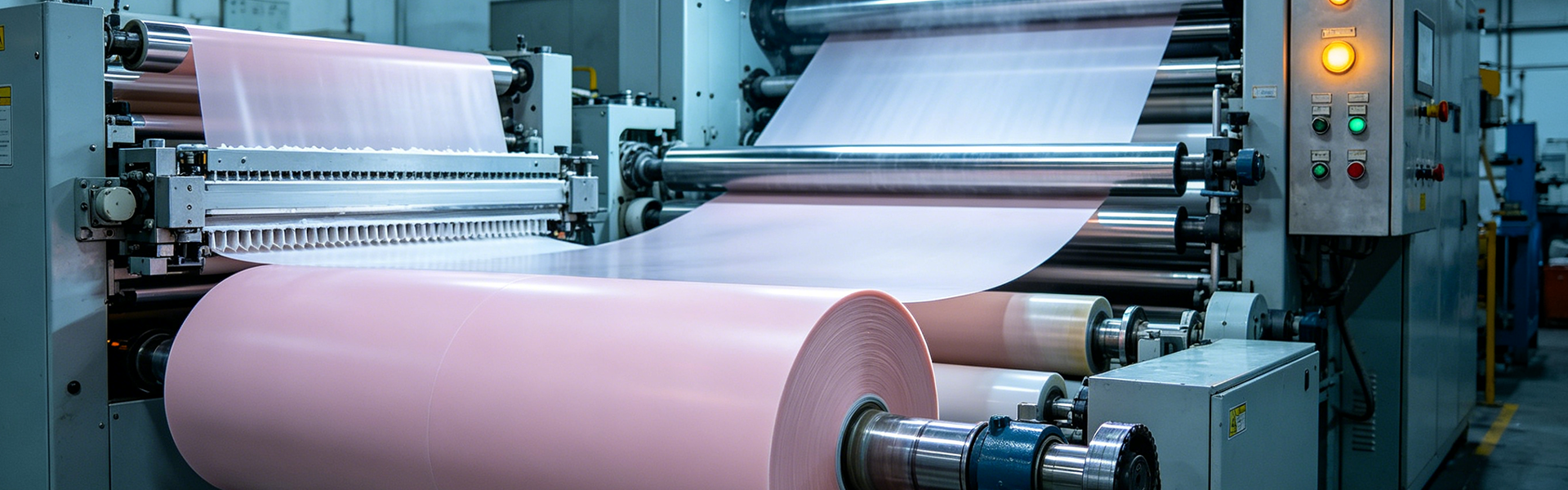
Ceramic-coated separators are now standard in high-energy NMC, NCA, and high-Ni cells. SEMITECH supplies fumed alumina as the dominant ceramic phase and fumed silica for slurry rheology control.
Why ceramic-coat the separator?
A bare polyolefin separator (PE or PP) shrinks above 130 °C and loses dimensional integrity well before thermal runaway. Ceramic coating closes that gap — and is now mandatory for high-energy automotive cells.
Ceramic coatings serve four functions simultaneously: thermal shutdown delay (intact ceramic skeleton holds shape past 180 °C), shrinkage suppression (less than 5% at 150 °C versus 30%+ for uncoated PE), electrolyte wettability (high surface area pulls electrolyte into pores), and dendrite suppression (mechanical barrier to lithium plating). Without ceramic coating, modern high-energy cells cannot pass thermal abuse tests like nail penetration or hot box.
How fumed alumina builds the ceramic layer
Fumed alumina (γ-Al₂O₃) is produced by flame hydrolysis of aluminum chloride, yielding aggregates of 13–50 nm primary particles fused into 200–500 nm clusters. The high BET surface area (80–130 m²/g) creates an open, porous coating that holds electrolyte while resisting compaction during calendaring. Fumed silica acts as the slurry stabilizer — its hydrogen-bond-driven gel network keeps alumina particles suspended during coating and prevents settling in the slurry tank.
Why fumed over precipitated alumina? Fumed grade has higher purity (>99.9% Al₂O₃), narrower particle size distribution, and more consistent batch-to-batch BET surface area — all critical for the ±0.5 μm coating thickness control that battery makers demand.
SEMITECH product lineup
Fumed Alumina · SEMIAL series
Primary particle 13–20 nm. BET 100–130 m²/g. >99.9% Al₂O₃. Hydrophilic surface. Three particle-size grades for thin-coat (2 μm) and thick-coat (6 μm) applications.
Fumed Silica · SEMISIL 200
Primary particle ~12 nm. BET 200 m²/g. Hydrophilic. Used at 0.5–1.5 wt % in alumina slurries to control viscosity, prevent settling, and improve coating uniformity.
Coating process integration
Ceramic-coated separators are produced in three main steps:
- STEP 1Slurry PrepFumed Silica
Disperse alumina in water/PVDF binder; fumed silica controls rheology.
- STEP 2CoatingGravure / Slot
Apply 2–6 μm wet film on PE or PP base separator.
- STEP 3Drying60–80 °C
Evaporate solvent without damaging porosity.
- STEP 4QCShrinkage Test
Hot oven test at 150 °C / 1 h verifies dimensional stability.
Selection guide
| Cell Type | Coating Thickness | Recommended Alumina Grade | Silica Loading |
|---|---|---|---|
| LFP (energy) | 2–3 μm | SEMIAL 13 | 0.5 wt% |
| NMC532 / NMC622 | 3–4 μm | SEMIAL 20 | 0.8 wt% |
| NMC811 / NCA | 4–6 μm | SEMIAL 30 | 1.0–1.5 wt% |
| Solid-state pilot | 5–10 μm | Custom | NDA project |
FAQ
+Can boehmite (γ-AlOOH) replace fumed alumina entirely?
For mid-energy LFP and NMC532 cells, yes — boehmite is lower cost and adequate. For NMC811, NCA, and high-rate cells, fumed alumina’s higher purity and narrower particle distribution remain preferred. Many manufacturers blend the two: boehmite for cost, fumed alumina for performance margin.
+Why use fumed silica in an alumina-based slurry?
Alumina particles tend to settle in water-based slurries within hours. Fumed silica forms a thixotropic gel network at 0.5–1.5 wt% loading that suspends alumina indefinitely while still allowing the slurry to flow when sheared during coating.
+What surface treatment do you offer?
Standard SEMIAL grades are hydrophilic for water-based slurries. Hydrophobic (PDMS or HMDS-treated) versions are available for solvent-based PVDF/NMP slurries on demand.
+What is the typical alumina-to-binder ratio?
Most water-based recipes use 90–95 parts alumina to 5–10 parts binder (PVDF, CMC, or acrylic latex). Fumed silica is added at 0.5–1.5 parts on top.
+Do you supply free samples for separator R&D?
Yes — 100 g and 1 kg trial sizes ship within 2 weeks. NDA-protected custom particle sizes require 4–6 weeks pilot lead time.
Part of the Lithium Battery Materials hub. Datasheets and COA available on request.