
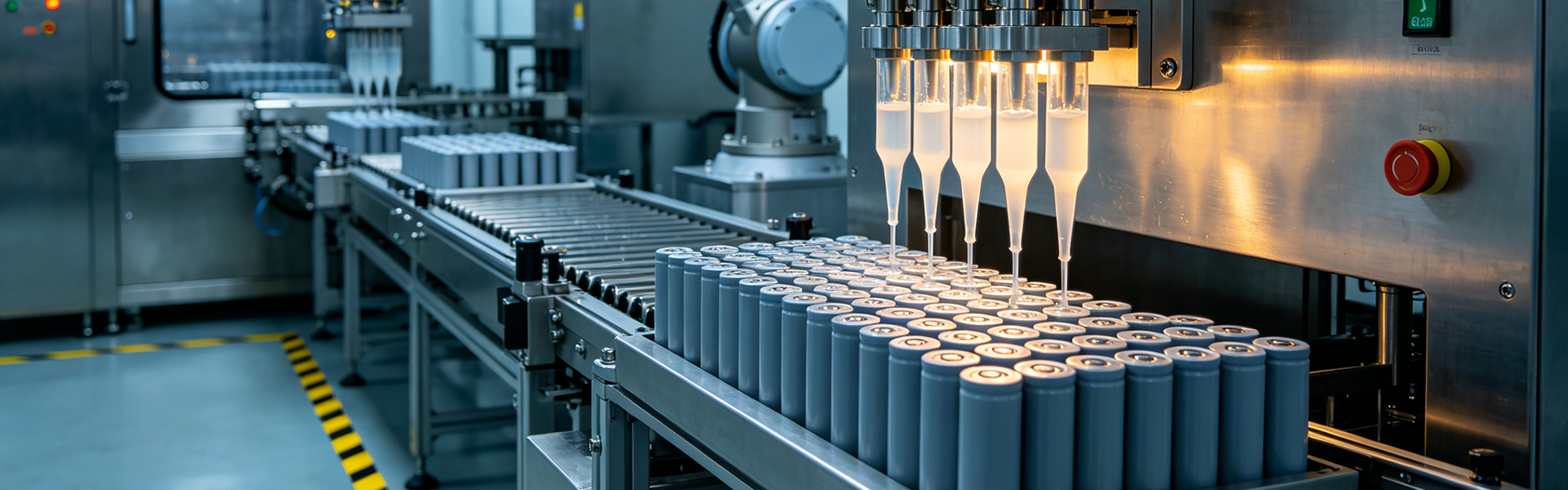
Liquid carbonate electrolytes leak. Fully solid electrolytes don't conduct fast enough. Gel polymer and semi-solid electrolytes split the difference — and fumed silica is the inorganic backbone that makes them work.
Why move beyond liquid electrolyte?
Liquid carbonate electrolytes are mature, conductive, and unsafe. Solid electrolytes are safe, slow, and decades from mass production. The middle ground — gel polymer (GPE) and semi-solid electrolytes — is shipping today.
Three commercial drivers push the industry toward gelation. Safety: gelled electrolytes don’t pool at puncture sites and reduce thermal runaway risk. Form factor: pouch and prismatic cells with gel electrolyte tolerate higher mechanical abuse. Energy density: semi-solid formulations enable thicker electrodes (250 μm+) without lithium plating, raising cell-level energy density 10–15%.
How fumed silica gels an electrolyte
Fumed silica’s surface is covered in silanol (Si–OH) groups that form hydrogen-bond networks. In a polar carbonate solvent (EC, DMC, EMC), these networks build a three-dimensional gel structure that immobilizes the liquid phase without restricting ion mobility. At 2–3 wt% loading, the gel is thick enough to suppress leakage but ionic conductivity drops less than 15% versus the parent liquid electrolyte.
Synergy with PVDF-HFP: Most commercial GPE formulations combine 2–3 wt% fumed silica with 5–10 wt% PVDF-HFP polymer. The polymer provides mechanical integrity; the silica provides rapid gel formation and retains it during cycling. Neither alone produces a stable gel under EV temperature swings.
Hydrophilic vs hydrophobic
Hydrophilic (SEMISIL 200)
Untreated silanol surface. Fastest gel formation in PC, EC-rich electrolytes. Standard for aqueous semi-solid binder slurries (water-based cathode and anode).
Hydrophobic (HMDS-treated)
Surface silanols capped with trimethylsilyl groups. Better compatibility with low-polarity solvents (DMC, EMC), more stable in long-term storage, recommended for high-voltage cells.
PDMS-treated
Long-chain silicone surface modification. Maximum hydrophobicity, used for water-sensitive applications and lithium metal anode pilot projects.
Custom doped
Lithium-functionalized surface (–OLi instead of –OH) under NDA development. Reduces lithium-ion adsorption losses for ultra-high-rate cells.
Loading guidelines
| Format | Silica Loading | Polymer | Notes |
|---|---|---|---|
| Standard GPE | 2–3 wt% | PVDF-HFP 5–10 wt% | Most common automotive recipe |
| Thin-cell GPE | 1–2 wt% | PVDF-HFP 4–6 wt% | Pouch, ultra-thin |
| Semi-solid (high loading) | 4–6 wt% | PEO + LiTFSI | Pilot, thick electrode |
| Solid-state composite | 5–15 wt% | Variable | R&D / pilot only |
Selection guide
Starting recipe (lab): 2.5 wt% SEMISIL 200 + 7 wt% PVDF-HFP in 1M LiPF₆ EC/DMC (1:1) — gels in < 30 minutes at 50 °C. Tune loading up for thicker pouch cells, down for thin cylindrical cells.
FAQ
+Will fumed silica reduce ionic conductivity?
Yes — but typically < 15% reduction at 2–3 wt% loading. The trade-off is favorable for safety and form-factor benefits. At loadings > 5 wt%, conductivity loss accelerates and is no longer worth it for most cell formats.
+Is fumed silica electrochemically stable?
SiO₂ is electrochemically inert in the typical 2.5–4.4 V window of Li-ion cells. At > 4.5 V (lithium-rich cathodes), some surface silanol oxidation has been reported, but does not compromise cell function under standard operating conditions.
+Does fumed silica trap moisture from electrolyte?
Hydrophilic grades can absorb < 1% moisture during open handling. We strongly recommend dry-room handling and pre-baking at 200 °C for 4 hours before incorporation. Hydrophobic grades reduce this risk substantially.
+Can fumed silica replace solid-state electrolyte?
No. Fumed silica enables gel and semi-solid electrolytes — both still contain liquid carbonate solvent. True solid-state electrolytes (sulfide, oxide, polymer) are a different chemistry. SEMITECH does supply nano alumina and silica fillers for solid-state composite electrolyte R&D.
+Do you offer custom surface modification?
Yes. Beyond standard HMDS and PDMS treatments, we develop custom surface chemistry under NDA — typical project timeline is 3–6 months from spec to first sample.
Part of the Lithium Battery Materials hub. Pilot-scale GPE formulation support available.